Category: development

  • Resources that helped me learn the Feldenkrais Method on my own

    Resources that helped me learn the Feldenkrais Method on my own

    Disclaimer: I do think that nothing beats actual practical hands on learning and if you are learning to help a loved one, nothing beats getting them to a real Feldenkrais Method practitioner – it will be years before your competence will match – if at all. However, if you are not able to get to one – for whatever reason, I have discovered that it is possible to be persistent and learn by simply seeking knowledge.

    Here is a list of resources that helped me. These resources are strictly from a “learning to help someone move better” perspective. Nisarga has Cerebral Palsy so it is possible that I focused on some more than others based on what I found useful. For the purposes of this list, I am including any practice that evolved from the Ferldenkrais method (such as the Anat Baniel Method) as well, since the fundamental method and attitude toward improvement is the same.

    Awareness Through Movement lessons

    Awareness Through Movement lessons or ATMS as they are called helped me understand my body tremendously and this helped me try and understand. What we use with children is “Functional Integration”. However, the approach toward helping the body learn movement is the same and our understanding helps us offer possibilities to the child better.

    The fundamentals of the Feldenkrais Method Approach

    Before you begin doing anything with your child (or adult) understand some things that are fundamental to the method. To do this, it is best to pay attention when you are reading, watching videos and so on for the principles that the practitioners think are important. These three things I had to keep coming back to more than others – they could be different for you:

    No pain, no forced movement

    I cannot stress this enough. With all the best intentions, I have found myself using too much force almost continuously in the beginning (and by beginning I mean first couple o YEARS) though fortunately not to the point of pain. Be warned that it is difficult to let go of the conditioning that makes us put in more effort when something doesn’t work. In such situations what invariably worked was LESS effort. Making the movement smaller, or slower or changing the position from it which was done. As in – no head on collissions with failure. Back off, go around try something similar with another limb and if you find yourself obsessing, just let go and do something else. Pain is a complete NO. This is not a bleeding heart thing, anything that causes pain will be avoided by the child. Your session will be wasted even in the unlikely situation you manage to break new ground.

    Clarity

    I found myself eager to do something. And I really mean something, anything. And that did not help. In fact it harmed. I started getting much better results when I did not touch Nisarga unnecessarily and move him without any idea of what I was trying to do. The importance of seeing the movement you are trying to do clearly in terms of how the body moves cannot be overstated. The more random clutter you add to what you are doing, the more you will end up confusing yourself and even if something works, you will have no idea how it worked.

    Building a library of movements

    Creating detailed mental views of how a movement plays out on the whole body in your mind – for example “what happens to my lower back if look up?” and not just “how does my head move to look up?” I don’t think this is ever complete, but if there was one thing that didn’t let me leverage one success to lead to others in a natural flow, it was this. I had to go back and study movements and see videos and do ATMS to see what possibilities existed in the new thing he had been able to do instead of spontaneously flowing to include the new abililty and working with it.

    Books that helped me learn

    Feldenkrais Method – Teaching by handling by Yochanan Ryewerant

    This is THE book that helped me understand how to do Functional Integration sessions. Any time I have no idea what I want to do in a session this is where I return. To pick up an idea, see how it can progress. The detailed descriptions and meticulous manner of explaining are like a window into the mind of a practitioner with extreme clarity on what and how the body moves. It isn’t a book that will absorb you or one that you can read from cover to cover in a go. More like a reference manual.

    Kids Beyond Limits by Anat Baniel

    This is less a book about therapy or the Feldenkrais Method or as she calls it the Anat Baniel Method alone and more a book that states the fundamentals of the learning process itself in a way that you remember. Specific chapters devoted to how you can expand your child’s potential by focusing specific things are very handy. I found this more of a book of how to create a learning environment rather than specific learning events alone. It is very useful if you want to create an environment that is constantly facilitative to learning. It will involve evolving how you are with your child. The most important thing I got from this book were the importance of taking things slow, reducing effort and providing variations. While the book is written for parents of children with disabilities, it is one that will help absolutely anyone.

    Body Awareness as Healing Therapy: The Case of Nora by Moshe Feldenkrais

    This book is actually a case study of the treatment of a woman who suffered a stroke and regressed severely with regard to functioning. This book is a must read because it is an insight into how holistic a view Moshe Feldenkrais took when working on a subject. The methods adopted in many cases are completely different from how we tend to visualize a Feldenkrais Method lesson. From psychology to practical efficiency and from devising methods to address specific things to completely geting into the skin of the subject to communicate in a manner that is most in tune. This is a must read because it is an extreme broadening of what we imagine we can try in order to create insight. In many ways this book was what brought it home for me how the movements while appearing to be the core of the method are merely a tool to communicate with the mind and the whole method is basically a way to get the mind to understand the body’s reality and understand what new ability will need. After reading this book, I found myself for the first time planning sessions that get Nisarga to participate in them as a thinking partner as opposed to someone I was trying to bring change to. He resonated with them better and they were more useful to him.

    Ways out of Cerebral Palsy during Infancy and Early Childhood with the Feldenkrais Method: A Study on Cerebral Palsy from the Perspective of Organic Learning in Early Childhood by Paul Doron Doroftei

    I have not read this book but I will be, very soon. I did not know this was published till searching for links to publish for this post. The reason I can recommend this without hesitation is that this is the same Paul Doron Doroftei who will also appear in the video references – he has Cerebral Palsy and grew to adulthood requiring a wheelchair till he was set free by Moshe Feldenkrais and his magic touch. Today he specializes in helping children thrive in spite of Cerebral Palsy. He is a practitioner who knows first hand exactly what it is like to live with Cerebral Palsy. I have absolutely no doubt that any book he writes on Cerebral Palsy will be extremely insightful and relevant to parents hoping to help their children. Highly recommended to anyone seeking to learn to work with Cerebral Palsy. Needless to say I will be reading this as soon as I get my hands on it.

    Beyond this, there are many many books available. Many of which are beyond my budget and thus I haven’t got around to reading them. The experiential nature of the method practically guarantees that a book by any experienced practitioner will contain distilled learnings from their own learning journey and practice. Here are books on the Feldenkrais Method available on Amazon. If there are books you found useful not mentioned, feel free to add them in the comments.

    Feldenkrais Method Videos on Youtube

    Youtube has many videos uploaded by practitioners of the Feldenkrais Method and parents of children in some cases. I have found many of them really useful to learn the Feldenkrais Method, because merely reading alone does not convey the quality of the movements. Also seeing the sessions unfold often brings insight into how movements are all interlinked.

    This section is going to be very big. At the moment I am trying to organize the videos that helped me the most. Till then, these are the youtube users that often have videos that have resulted in learning for me. I will try to upload a more detailed list of specific videos soon.

    Feldenkrais Institute

    Feldenkrais Movement Institute

    Paul Doron

    Anat Baniel

    MBS Academy

    Kim Wise

    Movement Lesson

    This list does not even attempt to begin to be complete. What I have in mind is a list of specific videos to watch and for what – a handy reference for when you need to understand something specific. It takes considerable time to watch the videos, keep track of links, write descriptions and so on, but it is close to completion and I hope to publish it within a day or two.

    This list has been a long time coming, and it is nowhere near complete and will be updated and improved with descriptions and more as I am able. I am publishing it in its incomplete form on the insistence of several parents who would like to begin exploring the resources immediately and discover new ones as I add them. I understand that with your child’s well being at stake, whether the post is completed is not as important as whether what is already there helps you. So do mark this page and keep checking on it on and off for additions.
  • Nisarga at the Indian Homeschooling Conference

    Just back from the Indian Homeschooling Conference in Khandala. I had taken Nisarga there. Our first major trip, only possible because a friend played a belated Santa Claus and procured for us a second hand framed backpack carrier from Australia (none available in India). This allowed me for the first time to put both Nisarga and most of our luggage on my back leaving my hands free and I was able to take on the challenge of taking him solo for a five day conference with all the luggage and travel it entails. It was tough, and heavy, but it was possible. The rest can be overcome with determination.

    And boy, am I glad I took the decision to go! It was a life affirming, enriching and informative experience.

    Right from the time when I met other homeschoolers to get on the shared bus (where I arrived due to a pick up from my parents home by a homeschooling family, where we stayed the previous night), compassion and help was abundant. To manage the luggage, to manage Nisarga for when my arms got weary… The bus was something of a misadventure for us. Nisarga got severely motion sick and suffered all the way. The only thing to do was a bath on arriving in Khandala.

    But the unpleasant start apart, the community was like coming home. We were at St. Mary’s Villa, which has a pretty big camus with large dormitories and enough accommodation for hundreds of people. Huge lawn and abundant play areas and beautiful views. Nisarga took one look at the kids running riot and wanted to be set down. He did not want to be picked  up again till we left unless it was to attend to some need. He was creeping all over the place and I gave up the idea of appearing a competent mother by keeping the child tidy. Over the next five days, he creeped on the floor everywhere. Indoors, outdoors, corridors, session areas, lawn, dining room… you name it. And I discovered just how much stamina a supposedly fragile child like him “who cannot even sit” actually has.

    He was interacting with people in unprecedented numbers on his own terms. Charming them, loving the attention, or creeping off lost in his own thoughts.

    The adults were wonderful. Whoever was in the vicinity had an eye on all the kids around. I never fell short of people who’d happily keep an eye on him while I took a breather. They sang songs to him, got him colors to play with, told him stories, carried him around showing him things…. or just walked along as he creeped off wherever the whim took him.

    Even more amazing was that there were sessions that he actually could participate in on his own level. Storytelling, salt dough play, the art corner to “draw” whatever he wanted and abundant music. We experimented with giving him paint to dip his hands into to paint when he had difficulty drawing with crayons or brushes. Alas, he painted his body and didn’t touch the paper for the most part. He tore chunks out of salt dough lumps, and when I shaped them into balls, picked them up and put them into a neighbouring child’s plate, where another adult promptly made a basket for all the “eggs”. The spontaneity and adaptability of being in the moment was what he thrived in.

    What was precious for me was the affirmation in being among like minded souls who didn’t so much as twitch an eyebrow over the idea of a parent challenging and discarding well engraved “best practices” if they didn’t work. I was astonished to realize that I was actually quite a great mom. Most of the time I’m just living in the moment, coping with life as it unfolds. The idea that I was doing it in a manner that in the opinion of others was enriching for my child was a novel and very gratifying experience after reconciling myself to being the sole person to blame for everything gone “wrong” with Nisarga, for not “obeying” doctors, for being …. unconventional and unapologetic about it. The idea that there could be not just individuals, but an entire community who thought what I was doing was absolutely fine and recognized that those choices were made because I was putting my son’s interest first was something I didn’t realize how much I needed till I experienced it.

    Another unique facet of this community was the kindness. Not just the adults, which one would expect with a lot of parents committed to a child led perspective. but the kids as well. With Nisarga creeping all over the place and preferentially haunting corridors, I had resigned myself to a few accidents with people tripping over him, or stepping on him apart from the inevitable well scrubbed hot bath on reaching home. To my astonishment, not one such accident happened. Here was a child getting underfoot with all kinds of hyperactivity happening around him – toddlers on tricycles and scooters, older children on various kinds of skates and skateboards, general running at full speed… and not one child trampled him. It is like they were aware of each other. They slowed and went around him without fail. I don’t remember seeing anyone tell them to be careful. They just did it on their own when they realized he was around.

    This, I guess is an outcome of sensitivity. Children learn from what they see more than what they are told. With parents being sensitive, that was the “idea” of how one can be that was available to them. In the five days, I did not see the children be unkind to each other. I didn’t notice any serious fights or telling tales of each other to adults. But more importantly, I didn’t see adults yelling at the children either. I didn’t see taunts, ridicule, insults, threats, orders or any of the many ways we usually see parents control their children. Children were doing what they like, including the occasional racket in the middle of a discussion, and they never even got told to keep quiet! How refreshing.

    The talent among the parents was incredible. There were at least three story tellers with their unique styles that could hold an audience spell bound. There was a long time homeschooling parent who was literally the Pied Piper of the conference. The kids would follow her where she led, do what she asked. There were sessions on toys from trash, natural farming, RTE and NIOS, guest sessions, home remedies and health, storytelling, “How many particles in the world”, birdwatching, a trip to the lake, peaceful parenting, creativity, FAQs for new homeschoolers and those who were guests come to find out more on the open day. And many more. There was so much for parents to earn and take home to improvise for their learning needs.

    And it was clear that parents and childrens were both learners when homeschooling.

    In the midst of all this, the children produced five short films, several plays, dances, countless individual performances of musical instruments, songs, recitals, jokes, sold crafts in a small mela…. I don’t know if any individual can describe everything that happened.

    As a long time homeschooler put it, if we don’t allow it to stress us, the noise of their excitement just becomes like say traffic noise. Ambient and it doesn’t bother a session. I saw that this was true. It really worked like that. This was indeed a good thing, because the few sessions I participated in with Nisarga, he babbled along with whoever was speaking very often. And it didn’t bother anyone. No complaints. No one turning around irritated at the disturbance. It was an amazing symbiosis. Parents and children operating fully intent on their respective goals and in the same space with no hassles. And when you talk of a community of hundreds, that is no mean feat.

    I think the surprise moment for me was when last night, a girl was going around with a sheet of paper and she asked me for my phone number. I gave it to her, and told her my name. She dismissed it saying she wanted the number for Nisarga! I guess this is the point when a parent realizes that their child has been forming their own relationships independently of the parent. Even if it is a child that can’t speak or even sit. Astonished doesn’t begin to cover my reaction in that moment.

    I could probably talk on and on, but there will be more updates that are less about Nisarga and me on the Homeschooling blog, so interested people could probably head over there.

    Nisarga has been quiet since we returned. He responds, but isn’t doing much on his own. I am wondering what is going on in that head. Is he assimilating or is he missing, or perhaps both? He hadn’t wanted to leave.

  • Fun at the AIIPMR

    Fun at the AIIPMR

    These are two activities at the AIIPMR that really helped Nisarga. He enjoyed doing them, and he was helped by them. In contrast, yesterday’s manipulations with his foot have left him with those stiff legs I was hoping we could leave in the past…

    Tracking the impact of various elements of therapy on him, so we can choose the more useful with time. Anyway, enjoy these pics 😀

    This is a foam tank full of spongy balls.


    They put Nisarga in this tank of balls and he was happy like a fish in water. The balls seem to provide slight support as well as sort of suspend him so that he is free to take the posture he is most comfortable in, regardless of gravity. He was picking up the balls one by one and throwing them into the bucket.

    IMG-20131006-WA0003


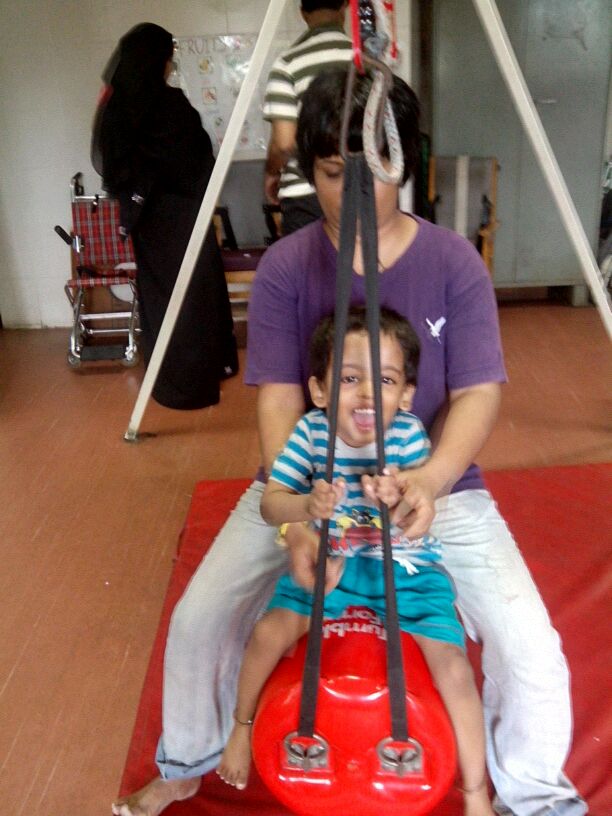
    This was another very useful activity, where he was made to sit straddled on this suspended roller and the roller was swung gently. I imagine it helps with trunk control, since at least that is what I could feel his back up to as I supported him. I sneaked in a few Feldenkrais touches and movements and I found him responding really well. The changes lasted well after the session, for a couple of days at least.

    Enhanced by Zemanta
  • Beautiful, brilliant day of learning

    I had been getting a bit pushy with Nisarga’s movement lessons. Needless to say, it was counterproductive. He was getting bored rapidly or cranky. I was getting frustrated at the lack of a breakthrough. So yesterday, I decided to back off (long overdue). I spent time reading about the Feldenkrais Method, reminding myself of what I was to do and what not to do. I watched videos on youtube. Returned to our session with a calmer mind, determined to do nothing, till it “happened”.

    And it happened. Boy how it happened!

    In one session, Nisarga learned to say “wawa” with a finger stuck in his mouth while saying “baba” so that his lips didn’t touch. Rapidly, he moved to more fingers, less fingers, stuffing T-shirt in his mouth and…. saying “wawa” erratically, but without anything preventing his lips from meeting and producing “ba” instead. Five minutes later, he was making a “guuuuh guuuuh” sound.

    I stopped while we were ahead, did some work with his back and legs and worked a bit with a “false floor” (another post about this maybe later). Today, as he was sitting straddling me as I lay on my back, he suddenly leaned forward, pushed with his legs and put his upper body weight on my arms (he still lacks strength) and voila! He was standing!!! Heavily supported and very brief, but the movement was there, the shift of weight on his legs, the straightening while pushing.

    I supported his elbows so he could put weight on them and he stood up even straighter. Transferred him to a lousy walker we have (need to get a better one) and with some encouragement and generous assistance, he was trying to pull himself into standing there as well.

    What a transformation from nothing happening yesterday, to everything buzzing today!!!

    And as always, it took me to dial down my hyperactivity, do less, listen more.

    In a brilliant, brilliant mood. Only wish I had someone who could run a camera while these moments were unfolding.


    Enhanced by Zemanta
  • Helping your special needs child move

    Disclaimer: I am not a doctor, any kind of professional related with child development or even very experienced in helping children, but I am able to use the Feldenkrais Method enough to help my son move better and I am learning daily.

    Here is a list of some of my own most important insights that help me the most when helping Nisarga to do something new. I think these are basically good ideas for any and all learning, but they become important with special needs kids, because they have limited energy to waste on things that are not useful. Where possible, I am providing my reasoning for the most common issues I run into when parents contact me for help.

    Warning: Some of these ideas will contradict what your physiotherapist says and I leave it to your judgment to choose what is most useful.

    • The goal: Forget perfection. It is not a useful goal for anyone, let alone a child who doesn’t need the pressure. No one is perfect. I can show how inefficiently your body moves, if you wish to be stuck on this.  What is important is continuous improvement. As long as each piece of learning builds on what was learned before, you’re in the green. Wait. Not so fast. Aim for a very high frequency of learning new things. Every minute is good. Every hour or every day works. Any less than that and you need to do more to help your child. It doesn’t have to be elaborate. It can be something as minor as “beating a new surface makes a new sound”. The key to recognizing this is an “aha” moment. Wide eyes, “Oh!” pause, grin that reflects a world of pride “loo what I did!”. <– this is the goal. Score as many as you can.
    • Nothing is wrong: Let go of the idea of “Wrong”. It is useless. Everything teaches something. Learn to value that. He didn’t “sit wrong”. Sitting in this way is not stable, or leaning like this will topple me. These are important discoveries too. Many results create a library of choice on what to do. Rolling over or waling is like learning t ride a bicycle too. You are able to do it not just by discovering what to do, but what to avoid as well. Celebrate those inputs for learning. The are building toward greater ability.
    • Think sharing more than training: The idea is to build possibilities for your child, not take him through motions or life. A child who cannot do something is not waiting for you to blackmail him or bribe him. He has a greater interest in sitting or standing than your bribe or anger. If you can’t raise your hand above your shoulder, it is no use me telling you I’ll buy you a laptop if you do it or yelling till you do. It is plain lack of support or bad manners. What use is an adult brain with knowledge of the movement if you can’t come up with an easier way for him? So you can’t raise your arm above your head, can you do it if you bend back or to the side? How far can you lift it? What becomes possible with the amount you CAN lift? If lifting hand fully is useful, even lifting hand somewhat is useful too. Find those uses. Let him experience that it is useful to HIM rather than something he can’t do that you expect from him.
    • Make it fun: If you’re acting like you’re saving him from disaster, it will not work. Keep your sense of fun. For example, last week, the doctor tried to teach Nisarga to put his weight on his arms by holding his elbows straight forcefully and holding him in the crawling position. Needless to say, Nisarga, not being able to crawl, did not have the strength or confidence for it, and he cried, and the doctor would have simply overruled him and continued through the crying as something necessary. I didn’t become popular when I stopped her, but two minutes later, I had him in that same position from a different starting position (which he found easier) without holding his elbows. The minute the doctor tried to get involved, he started crying and that was that. The doctor had lost his trust by making the experience unhappy for him.
    • Crying through learning is not learning: Learning is fun. The idea is that the child learns something that he can then do on his own. If the experience is an unhappy one, forcing him to a sitting position will never lead him to WANTING to sit. There’s your war lost over a battle. Even if he can, he will be likely to associate it with something undesirable. Kids are resilient, and will choose opportunities to grow by default, but it is an unnecessary hindrance a child with limited ability does not need. It does not make sense to add unpleasant experiences to be overcome in the way of their growth. No pain no gain is a myth. Science now shows that the damage indicated by the pain needs to be overcome for further progress and over-training SLOWS improvement. Star athletes no longer train to the point of pain. Your child is a star pursuing his peak performance too. Not all that different. It is very easy to over-train, over-tire a child already having difficulties with movement. Take your cues from the child, not prescriptions of what “should” be done.
    • Have variety: This is probably the most important thing, because most physiotherapy will be doing the opposite. Repititions are useless. If he’s experienced one, he’s experienced them all, except for the fatigue, which is not a useful goal. Keep changing things. If he sat up on one way, change something. Change position of hand, position of leg. Elevate his head or legs – does that help? Change direction of sitting. Change speed. Vary, vary, vary. Keep him interested, engaged, watching out for what’s changing and what that will mean. That gives him a library of what to do and what not to do faster than a movement repeated on auto-pilot.
    • Dial it down: The instinct on facing failure is to get frantic, try harder. This is counter-productive. More force into a thing that is not working only makes it more difficult to change. Slow down. Start the movement and return without doing it. Use much less force – you aren’t even planning to complete the movement, just seeing what happens like that. That laid back I’m talking. If something is not happening, back off. Take a look at what is happening without trying to fix it. You need to know what’s happening, to fix it, right? So you tried to make him stand, but he’s not able. So it is okay. Go to your starting position. How is he sitting? If you were sitting like that, would you be able to get up easily? What would you have to do *before* standing up? Is he doing it? What happens if you move him like that without making him do anything at all? Can you move him easily in the manner you would, if you were getting up? If you can’t, forget him being able to. If you can, can you get him to do that tiny initial movement without worrying about the end result? What happens? Is he able to do it? Does he move “wrong” instead? Explore, explore, explore. Forget the standing. Find out what is happening. Help him find out. If this doesn’t work, still don’t get frantic. Do something else altogether that he can do. Return here another time. Remember this: No matter how important the end resulting movement is, in your view, adding energy to something that isn’t working will only fix it in the wrong way. So that is a no-no regardless of whether something else works or not. Just forget it and other ideas will start popping up.

    These, I think are the most important things I learned to do to be able to teach Nisarga effectively. Most of these have been inspired by principles of unschooling, behavioral learning theories/experiences and the Feldenkrais Method (They aren’t all that different – only pragmatic and scientific thinking applied to different aspects). To date, if working with Nisarga runs into failure, it is guaranteed I’m doing one of these wrong, and I have to take a look at myself and consciously stop doing things that hinder progress. Usually just dialing down the hyper-activity in me will help the situation considerably.

    Hope this helps. Me not being expert or having experience talking about this, I’m not sure if it has come across clearly, but I am convinced from all my learning and experiences that all these are excellent ideas that are crucial to adopt to help learning in general and for special needs in particular and the opposite of these ideas is harmful. Feel free to use the comments to start a dialogue.

    Enhanced by Zemanta
  • Feldenkrais method for kids: Sitting straighter, using hands more

    Feldenkrais method for kids: Sitting straighter, using hands more

    Posture Analysis:

    Nisarga’s development seemed stuck with him sitting hunched, braced against his hands or rather the back of his hands. Looking at some videos of using the Feldenkrais Method with kids and reading and mimicking his posture, I realized that this too is a manifestation of him not using his lower back. His knees turn inward as well and muscle tension is a constant to overcome for most movements. He was not comfortable sleeping on his back, though he is able to sleep on his back easily now after some work I did last month. When crawling, his legs stick straight out and stiff without movement. There is very little self awareness that can be leveraged to help him differentiate these movements enough to alter habitual patterns.

    Nisarga W-sitting

    His hands are often clenched and he avoids touch on the palm of his hands, preferring to use the back of his hands to push against the floor. Similarly, he avoids contact with the soles of his feet, lifting his legs if you try to stand him up or not bearing any weight on them. There is hardly any muscle tone. Recent sessions have allowed him to be comfortable resting them on the floor while in a rocking chair or walker, without putting weight on them.

    In terms of posture analysis, he is often like a diver in the middle of a somersault. Upper body curved, legs tight together, straight out at an angle. Except he also hunches his shoulders in and his legs turn inward as well.

    The Feldenkrais Method resources I found useful for this:

    It was easier said than done, but three consecutive movement therapy lessons based on functional integration movements from Yochanan Ryewerant’s book “The Feldenkrais Method: Teaching by Handling” have shown small but definite improvements. I also got many practical ideas from Michelle Turner’s excellent video series on Functional Integration lessons with children using the Feldenkrais Method.

    The Feldenkrais Method Functional Integration movements I did:

    Self awareness is half the battle. In various functional integration movements, I helped him learn to move his pelvis to support his lower back better, resulting in an immediate straightening of his spine while his lower back was engaged. Particularly useful was gently rocking his pelvis forward while he played and touching the top of his head so he had some self awareness how he became taller as his back straightened. Rounding his back by pushing lightly from his lower chest and then straightening it by pressing lightly on his lower back.

    I did another variation of this with him lying on his side, which really seemed to register on his self awareness as it is not a movement we do normally and he did not have to worry about bearing weight or balance. Additionally, and possibly unrelated, I worked with very gentle movements of his toes till his legs started relaxing more. I think the muscle tension in his whole body relaxed and there was more ease, but it was not such an immediately observable change for whole body.

    I was not able to video shoot these functional integration lessons, because I don’t have anyone assisting me and also because he becomes instantly distracted by a camera. I have never been able to set it up without him noticing.

    He still forgets to sit straight, but now that he can, if he wants to, he is able to do a lot more movements than before. All of a sudden. Adding something new with each session.

    The Results

    He still uses his hands for balance, but is sitting up more often and also uses his hands for balance more often than bearing his weight. He has started rocking back and forth while sitting in a W-sit. He has started enjoying being rocked side to side (shifting weight from one buttock to the other) if done in rhythm with music. He has started using the palms of his hands more often than the back of his hand, which was usual up to this series of functional integration lessons.

    He used to grab my hair to pull my head down to plant kisses on it all the time. He loves it. So I have started not bending when he pulls and letting him come up to me instead. He has started pulling himself up on his knees if he can get a fistful of my hair (it hurts, but considering that it is one of the very few things he grabs strongly and willingly, I am glad he does it). His back is not strong enough to do it well yet, but once in a while he surprises himself by standing on his knees. Grin, kiss, fall back into a sit. This is something he had started briefly last month, but is able to do it slightly better after these sessions.

    He has started babbling a lot more and using his hands more readily.

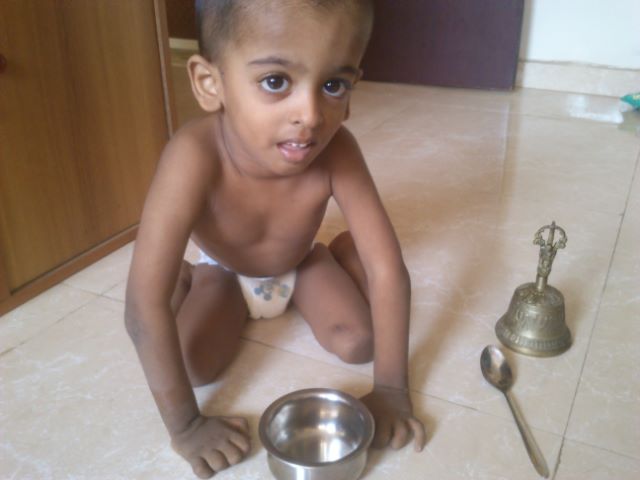
    He is also showing definite improvements with how he uses his hands. He takes out a spoon from a bowl, and then puts it back in. Gave him a rounded pot with a deep dish that fits in the mouth like a cover and he played with it in a variety of ways putting one on top of the other, putting on as lid, taking off, putting my mobile phone in the pot and putting on the “lid”… All this is new and has managed to alter habitual patterns of immediately releasing anything he grasped. All of a sudden he seems to be discovering a wide range of possibilities to try out. I believe this too is a direct result of his hands being easier to free now that he doesn’t use them as much for bearing weight.

    There is a new self awareness that has him pausing and taking stock when confronted with something new as though evaluating potential before engaging.

    His is normally constipated, but in last three days his bowel movements have been fine. Though this may be related or a coincidence.

    All in all, an exciting time and for the first time, I am experiencing that I am actually able to help him to learn movement. Strikes me anew just how much I need to learn. At the moment, it is better than last year, but many sessions don’t seem to strike any note with him. I see this as a direct result of me lacking the knowledge to choose movements that will help him. In the last few months, my skill has improved, and it is helping him dramatically.

    Note: Parents in India often ask me if I will help their child. I will, but please note that I am a self learned practitioner and am not a better option than finding a real one, which may be near impossible in India, but possible if you go abroad. Also note that I will not be able to travel to your home for it. You will have to come here, though you are welcome to come and even stay for a few days if you find it useful.

  • Yes, yes yes!!!

    Nisarga’s dystonia means he uses his body in a quite twisted way. To push against the floor, he uses the back of his hands instead of palm. It has been a struggle for over a year now to keep patiently correcting it by turning his hand over so that his palm pushes against the floor. Of course, I can’t do it every time, but as often as possible.

    With the new medication, he has been more open to using his palms, though he still uses the back of his hand a lot.

    Today, when I corrected how his hands were resting, he put his head down, so that he was sleeping on his stomach with his forearms and palms against the floor palms in line with his shoulders. And something I had made a mental note of clicked in that position. He could push up with minimum effort.

    Now, this is a very good position to push up on hands and knees. One which I tried to “place” him into, but he is very touch sensitive, so he doesn’t stay like that.

    Using the opportunity, I supported his waist slightly to take off some of the weight and make it easy for him to try coming up on his hands and leaned over him so that he looked up at me, and very naturally, he raised himself till his hands extended and reflexively got his knee under him, and there we were!

    Both of us surprised. Me surprised because after all those battles trying to teach him, when I really went with what he was already doing [I tried always, but I am learning from youtube videos – don’t have the skill of those guys], it was so ridiculously simple to help him to it! He, because he found himself in a totally different position with a lot of possibilities.

    Big grins.

    I refrained from over reacting, because that kind of freezes him. He has done it with a random movement that worked, he still doesn’t understand what to duplicate if I tell him to do it again. So we played, and then again, when he was in a similar position, I touched his waist and he came up on one knee and hands.

    Then again. Some four or five times. Differently each time. He is experimenting. And it is so beautiful. I went to the loo and cried some happy tears.

    We are finally up on our hands and knees and making some attempts to crawl mixed up with it. Yay!!!!

    Another moment when I wished so much that someone was around to wield a camera!

  • Another breakthrough with ad hoc Feldenkrais Method

    Those following this blog for long know that I have been learning the Feldenkrais Method on my own (and not too well) from videos found online and books and training videos purchased on the internet. Basically, this being such an experiential knowledge, simply watching or words are not really “enough”, but in the absence of a practitioner within reach, and with my belief in the Method, I am doing what I can.

    So, after a long plateau, during which, I lost motivation, etc. I ended up taking a break. Then I began again a few days ago. The first day or so was… okay… nothing really happened, but three days ago, something suddenly clicked for Nisarga with how he uses his back (or rather how he didn’t use his back, but could). That session exploded into possibilities.

    Difficult to put into words, but the end result is that Nisarga is now much more happy about holding and banging toys, which he had lost when he regressed. He has also started applying his knee to the floor to help his creeping. He requires lesser assistance in sitting up, and is able to maintain his sitting much better than before. His back is more relaxed and the curve in his spine doesn’t show as much.

    I suppose all this would have happened much earlier in the hands of a skilled practitioner, since for me it is an awkward process of remembering movement possibilities I had noted in videos, seeing how any of them might fit what we are doing, innovating based on them, being sensitive to Nisarga’s body and mind… many things at once… I am not skilled enough yet for it all to just instinctively happen, as it does for those with more experience, but I guess it is far superior to not having known about the method at all.

    He just figured out that his back could do more than he was using it for, and it kind of flowed from there. Very optimistic. Watching videos and reading a lot again, so that I can use this breakthrough and we can figure out more ways the body has potential…

    This is also good on another level, because I was getting a lot of flak for discontinuing his Physiotherapy on my own initiative, because it wasn’t helping and he seemed to be getting stiffer from all the demands of applying strength to achieve something that was basically movement. It was also making his scoliosis more pronounced (not that any of the doctors noticed that or agreed when I pointed it out until the recent doctor from Vile Parle), which I found worrying. The doctor had prescribed braces, but to me it made more sense to get rid of the tenseness than to prevent it from showing as a distortion.

    In any case, with over 6 months of physio, he hadn’t really achieved any particular milestone – he still wasn’t sitting or crawling, creeping erratically… and any progress from one session was not lasting unless repeated constantly. That isn’t learning. But to me, as a mother with a “non-performing” child, it had become about defending a decision made with considerable thinking, observing and soul searching in the face of those who insisted on the proper procedure being followed, recommended training being given, etc.

    *Sigh* it always seems to be a fight between responsive choices and choices deemed right by the world.

    Anyway, he is creeping far more fluidly than the physiotherapy allowed him, his scoliosis is relaxing again, and I can SHOW the difference to skeptics – which definitely helps.

  • The neurologist and Syndopa

    Today, my birthday. No one at home but Nisarga and I. Big plan for the day? Meeting with Dr. Anaita Hegde, who is supposed to be the top or second from top pediatric neurologist in Mumbai. A few odd thoughts sent through my mind:

    • How can a doctor be ranked top or second from top, etc? Do they have contests or something?
    • Frankly, I didn’t think Nisarga’s symptoms are neurological. Or they might be, but I used to think its related with his lack of head control and increasingly scoliotic tendency because of that (in my mind), but as a parent, I didn’t have the guts to not act on any advice I get – and a child specialist had said that I must meet a very senior pediatric neurologist.
    • Difficult getting appointments, so its really a birthday gift that we were able to meet her and it turned out to be a very good meeting.

    The meeting went very well. We went with all our increasing paperwork and ended up waiting a lot. Nisarga dozed off and I asked them to let a few of the other waiting patients through before us so that he could be well rested when we met the doctor. Since everything was running HOURS behind schedule, they were grateful for my offer. Of course, I was being utterly selfish. If I had to shell out a lot of money consulting a fancy doctor, I wanted Nisarga bright and cheerful, not wilted from waiting, so that she could really interact with him and examine and whatever it is these people are supposed to do.

    While we waited, Dr. Anaita’s assistant (a neurologist herself) came and took a detailed case history. As meetings go, this was probably the most surprising and best of the lot. Dr. Hegde interacted with Nisarga and he was at his charming best. She made quite a few observations related with him scissoing his legs, not being comfortable on his back and other things, and had some conversation and a eureka kind of moment with her assistant.

    She was concerned about his regression. He gets these developments, and he loses them. For example, after the bouts of bua bua ba ba boooa etc, he isn’t babbling much at all, while I was expecting him to speak more post that. There are other things too.

    She has prescribed something called Syndopa, which is supposed to fix some chemical deficiency in his brain. No side effects, but a miracle cure if it works out. She explained that it was a long shot, but some of the symptoms made her think it was worth trying. Just as we were leaving, she took note of his history of slight jaundice immediately after birth, and considered the possibility that there may be some brain damage – even though the MRI was clear.

    I spoke with her about the Feldenkrais work I do with Nisarga. She was very supportive and went to the extent of saying that if it is helping him, to not even ask any more doctors, because he is really the final judge. To not even risk someone asking me to stop! It was a big surprise after the unrelenting skepticism of most doctors so far.

    Brought him home, fed him, gave him his first dose of Syndopa. Perhaps its my imagination, but after his second dose, I think he is more active. Fingers crossed.

  • Anat Baniel method of Feldenkrais in India

    Okay, this is what I have been up to these days. Nisarga’s development still seems behind schedule and the attitude of his pediatrician is wait and see. That seems fine, since he isn’t ill or unhappy, but I was getting concerned about his lack of movements.

    A lot of research online led me to discover the Feldenkrais method and then the Anat baniel method for children.What I liked was the attitude of sensitivity to the child’s comfort and the focus on creating learning experiences rather than training or therapy. I was eager to have this for Nisarga, but there aren’t any practitioners in India. Not to be stopped, I have turned my considerable aptitude for learning toward this and learned through reading and teaching materials purchased online.

    I tried to understand the principles and used the abundant videos on YouTube to see example after example of them in action and started applying these learnings to assist Nisarga. It started showing results almost immediately. I felt encouraged and worked further, helping Nisarga to roll over and gain neck control.

    Then, I became complacent, till I realized that he is now 8 months old and still not sitting or crawling, and have been working with him gain for the last few days. Again, I am encouraged to see that within four days he learned to hold his back straighter, sits with very little support, uses two hands to play with toys and as of today, has started crawling – all of which he was not able till four days ago.

    What began as a disappointment over lack of access to practitioners is leading to me becoming a practitioner!I am not a certified practitioner, but I would be happy to work with other children who need help with motor development. I am not promising any competence and of course, if, unlike me, you can fly abroad and get those experts to work with your child, its best. But if that is not possible for you, I dare say that this may be worth a shot. If it doesn’t work, it doesn’t harm for sure. But if it does… the changes in Nisarga in the last four days are miraculous.

    Of course, in an ideal world, I will be able to afford to fly abroad to learn when Nisarga is older. Or, there may be other practitioners who begin working in Mumbai…