Category: Feldenkrais

  • Resources that helped me learn the Feldenkrais Method on my own

    Resources that helped me learn the Feldenkrais Method on my own

    Disclaimer: I do think that nothing beats actual practical hands on learning and if you are learning to help a loved one, nothing beats getting them to a real Feldenkrais Method practitioner – it will be years before your competence will match – if at all. However, if you are not able to get to one – for whatever reason, I have discovered that it is possible to be persistent and learn by simply seeking knowledge.

    Here is a list of resources that helped me. These resources are strictly from a “learning to help someone move better” perspective. Nisarga has Cerebral Palsy so it is possible that I focused on some more than others based on what I found useful. For the purposes of this list, I am including any practice that evolved from the Ferldenkrais method (such as the Anat Baniel Method) as well, since the fundamental method and attitude toward improvement is the same.

    Awareness Through Movement lessons

    Awareness Through Movement lessons or ATMS as they are called helped me understand my body tremendously and this helped me try and understand. What we use with children is “Functional Integration”. However, the approach toward helping the body learn movement is the same and our understanding helps us offer possibilities to the child better.

    The fundamentals of the Feldenkrais Method Approach

    Before you begin doing anything with your child (or adult) understand some things that are fundamental to the method. To do this, it is best to pay attention when you are reading, watching videos and so on for the principles that the practitioners think are important. These three things I had to keep coming back to more than others – they could be different for you:

    No pain, no forced movement

    I cannot stress this enough. With all the best intentions, I have found myself using too much force almost continuously in the beginning (and by beginning I mean first couple o YEARS) though fortunately not to the point of pain. Be warned that it is difficult to let go of the conditioning that makes us put in more effort when something doesn’t work. In such situations what invariably worked was LESS effort. Making the movement smaller, or slower or changing the position from it which was done. As in – no head on collissions with failure. Back off, go around try something similar with another limb and if you find yourself obsessing, just let go and do something else. Pain is a complete NO. This is not a bleeding heart thing, anything that causes pain will be avoided by the child. Your session will be wasted even in the unlikely situation you manage to break new ground.

    Clarity

    I found myself eager to do something. And I really mean something, anything. And that did not help. In fact it harmed. I started getting much better results when I did not touch Nisarga unnecessarily and move him without any idea of what I was trying to do. The importance of seeing the movement you are trying to do clearly in terms of how the body moves cannot be overstated. The more random clutter you add to what you are doing, the more you will end up confusing yourself and even if something works, you will have no idea how it worked.

    Building a library of movements

    Creating detailed mental views of how a movement plays out on the whole body in your mind – for example “what happens to my lower back if look up?” and not just “how does my head move to look up?” I don’t think this is ever complete, but if there was one thing that didn’t let me leverage one success to lead to others in a natural flow, it was this. I had to go back and study movements and see videos and do ATMS to see what possibilities existed in the new thing he had been able to do instead of spontaneously flowing to include the new abililty and working with it.

    Books that helped me learn

    Feldenkrais Method – Teaching by handling by Yochanan Ryewerant

    This is THE book that helped me understand how to do Functional Integration sessions. Any time I have no idea what I want to do in a session this is where I return. To pick up an idea, see how it can progress. The detailed descriptions and meticulous manner of explaining are like a window into the mind of a practitioner with extreme clarity on what and how the body moves. It isn’t a book that will absorb you or one that you can read from cover to cover in a go. More like a reference manual.

    Kids Beyond Limits by Anat Baniel

    This is less a book about therapy or the Feldenkrais Method or as she calls it the Anat Baniel Method alone and more a book that states the fundamentals of the learning process itself in a way that you remember. Specific chapters devoted to how you can expand your child’s potential by focusing specific things are very handy. I found this more of a book of how to create a learning environment rather than specific learning events alone. It is very useful if you want to create an environment that is constantly facilitative to learning. It will involve evolving how you are with your child. The most important thing I got from this book were the importance of taking things slow, reducing effort and providing variations. While the book is written for parents of children with disabilities, it is one that will help absolutely anyone.

    Body Awareness as Healing Therapy: The Case of Nora by Moshe Feldenkrais

    This book is actually a case study of the treatment of a woman who suffered a stroke and regressed severely with regard to functioning. This book is a must read because it is an insight into how holistic a view Moshe Feldenkrais took when working on a subject. The methods adopted in many cases are completely different from how we tend to visualize a Feldenkrais Method lesson. From psychology to practical efficiency and from devising methods to address specific things to completely geting into the skin of the subject to communicate in a manner that is most in tune. This is a must read because it is an extreme broadening of what we imagine we can try in order to create insight. In many ways this book was what brought it home for me how the movements while appearing to be the core of the method are merely a tool to communicate with the mind and the whole method is basically a way to get the mind to understand the body’s reality and understand what new ability will need. After reading this book, I found myself for the first time planning sessions that get Nisarga to participate in them as a thinking partner as opposed to someone I was trying to bring change to. He resonated with them better and they were more useful to him.

    Ways out of Cerebral Palsy during Infancy and Early Childhood with the Feldenkrais Method: A Study on Cerebral Palsy from the Perspective of Organic Learning in Early Childhood by Paul Doron Doroftei

    I have not read this book but I will be, very soon. I did not know this was published till searching for links to publish for this post. The reason I can recommend this without hesitation is that this is the same Paul Doron Doroftei who will also appear in the video references – he has Cerebral Palsy and grew to adulthood requiring a wheelchair till he was set free by Moshe Feldenkrais and his magic touch. Today he specializes in helping children thrive in spite of Cerebral Palsy. He is a practitioner who knows first hand exactly what it is like to live with Cerebral Palsy. I have absolutely no doubt that any book he writes on Cerebral Palsy will be extremely insightful and relevant to parents hoping to help their children. Highly recommended to anyone seeking to learn to work with Cerebral Palsy. Needless to say I will be reading this as soon as I get my hands on it.

    Beyond this, there are many many books available. Many of which are beyond my budget and thus I haven’t got around to reading them. The experiential nature of the method practically guarantees that a book by any experienced practitioner will contain distilled learnings from their own learning journey and practice. Here are books on the Feldenkrais Method available on Amazon. If there are books you found useful not mentioned, feel free to add them in the comments.

    Feldenkrais Method Videos on Youtube

    Youtube has many videos uploaded by practitioners of the Feldenkrais Method and parents of children in some cases. I have found many of them really useful to learn the Feldenkrais Method, because merely reading alone does not convey the quality of the movements. Also seeing the sessions unfold often brings insight into how movements are all interlinked.

    This section is going to be very big. At the moment I am trying to organize the videos that helped me the most. Till then, these are the youtube users that often have videos that have resulted in learning for me. I will try to upload a more detailed list of specific videos soon.

    Feldenkrais Institute

    Feldenkrais Movement Institute

    Paul Doron

    Anat Baniel

    MBS Academy

    Kim Wise

    Movement Lesson

    This list does not even attempt to begin to be complete. What I have in mind is a list of specific videos to watch and for what – a handy reference for when you need to understand something specific. It takes considerable time to watch the videos, keep track of links, write descriptions and so on, but it is close to completion and I hope to publish it within a day or two.

    This list has been a long time coming, and it is nowhere near complete and will be updated and improved with descriptions and more as I am able. I am publishing it in its incomplete form on the insistence of several parents who would like to begin exploring the resources immediately and discover new ones as I add them. I understand that with your child’s well being at stake, whether the post is completed is not as important as whether what is already there helps you. So do mark this page and keep checking on it on and off for additions.

  • Beautiful, brilliant day of learning

    I had been getting a bit pushy with Nisarga’s movement lessons. Needless to say, it was counterproductive. He was getting bored rapidly or cranky. I was getting frustrated at the lack of a breakthrough. So yesterday, I decided to back off (long overdue). I spent time reading about the Feldenkrais Method, reminding myself of what I was to do and what not to do. I watched videos on youtube. Returned to our session with a calmer mind, determined to do nothing, till it “happened”.

    And it happened. Boy how it happened!

    In one session, Nisarga learned to say “wawa” with a finger stuck in his mouth while saying “baba” so that his lips didn’t touch. Rapidly, he moved to more fingers, less fingers, stuffing T-shirt in his mouth and…. saying “wawa” erratically, but without anything preventing his lips from meeting and producing “ba” instead. Five minutes later, he was making a “guuuuh guuuuh” sound.

    I stopped while we were ahead, did some work with his back and legs and worked a bit with a “false floor” (another post about this maybe later). Today, as he was sitting straddling me as I lay on my back, he suddenly leaned forward, pushed with his legs and put his upper body weight on my arms (he still lacks strength) and voila! He was standing!!! Heavily supported and very brief, but the movement was there, the shift of weight on his legs, the straightening while pushing.

    I supported his elbows so he could put weight on them and he stood up even straighter. Transferred him to a lousy walker we have (need to get a better one) and with some encouragement and generous assistance, he was trying to pull himself into standing there as well.

    What a transformation from nothing happening yesterday, to everything buzzing today!!!

    And as always, it took me to dial down my hyperactivity, do less, listen more.

    In a brilliant, brilliant mood. Only wish I had someone who could run a camera while these moments were unfolding.


    Enhanced by Zemanta
  • Feldenkrais method for kids: Sitting straighter, using hands more

    Feldenkrais method for kids: Sitting straighter, using hands more

    Posture Analysis:

    Nisarga’s development seemed stuck with him sitting hunched, braced against his hands or rather the back of his hands. Looking at some videos of using the Feldenkrais Method with kids and reading and mimicking his posture, I realized that this too is a manifestation of him not using his lower back. His knees turn inward as well and muscle tension is a constant to overcome for most movements. He was not comfortable sleeping on his back, though he is able to sleep on his back easily now after some work I did last month. When crawling, his legs stick straight out and stiff without movement. There is very little self awareness that can be leveraged to help him differentiate these movements enough to alter habitual patterns.

    Nisarga W-sitting

    His hands are often clenched and he avoids touch on the palm of his hands, preferring to use the back of his hands to push against the floor. Similarly, he avoids contact with the soles of his feet, lifting his legs if you try to stand him up or not bearing any weight on them. There is hardly any muscle tone. Recent sessions have allowed him to be comfortable resting them on the floor while in a rocking chair or walker, without putting weight on them.

    In terms of posture analysis, he is often like a diver in the middle of a somersault. Upper body curved, legs tight together, straight out at an angle. Except he also hunches his shoulders in and his legs turn inward as well.

    The Feldenkrais Method resources I found useful for this:

    It was easier said than done, but three consecutive movement therapy lessons based on functional integration movements from Yochanan Ryewerant’s book “The Feldenkrais Method: Teaching by Handling” have shown small but definite improvements. I also got many practical ideas from Michelle Turner’s excellent video series on Functional Integration lessons with children using the Feldenkrais Method.

    The Feldenkrais Method Functional Integration movements I did:

    Self awareness is half the battle. In various functional integration movements, I helped him learn to move his pelvis to support his lower back better, resulting in an immediate straightening of his spine while his lower back was engaged. Particularly useful was gently rocking his pelvis forward while he played and touching the top of his head so he had some self awareness how he became taller as his back straightened. Rounding his back by pushing lightly from his lower chest and then straightening it by pressing lightly on his lower back.

    I did another variation of this with him lying on his side, which really seemed to register on his self awareness as it is not a movement we do normally and he did not have to worry about bearing weight or balance. Additionally, and possibly unrelated, I worked with very gentle movements of his toes till his legs started relaxing more. I think the muscle tension in his whole body relaxed and there was more ease, but it was not such an immediately observable change for whole body.

    I was not able to video shoot these functional integration lessons, because I don’t have anyone assisting me and also because he becomes instantly distracted by a camera. I have never been able to set it up without him noticing.

    He still forgets to sit straight, but now that he can, if he wants to, he is able to do a lot more movements than before. All of a sudden. Adding something new with each session.

    The Results

    He still uses his hands for balance, but is sitting up more often and also uses his hands for balance more often than bearing his weight. He has started rocking back and forth while sitting in a W-sit. He has started enjoying being rocked side to side (shifting weight from one buttock to the other) if done in rhythm with music. He has started using the palms of his hands more often than the back of his hand, which was usual up to this series of functional integration lessons.

    He used to grab my hair to pull my head down to plant kisses on it all the time. He loves it. So I have started not bending when he pulls and letting him come up to me instead. He has started pulling himself up on his knees if he can get a fistful of my hair (it hurts, but considering that it is one of the very few things he grabs strongly and willingly, I am glad he does it). His back is not strong enough to do it well yet, but once in a while he surprises himself by standing on his knees. Grin, kiss, fall back into a sit. This is something he had started briefly last month, but is able to do it slightly better after these sessions.

    He has started babbling a lot more and using his hands more readily.

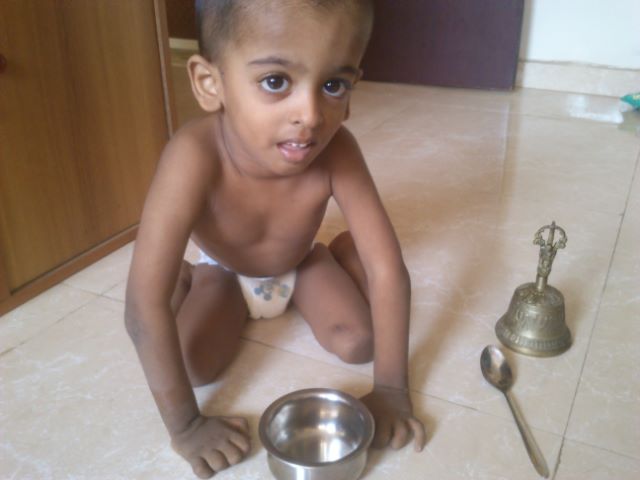
    He is also showing definite improvements with how he uses his hands. He takes out a spoon from a bowl, and then puts it back in. Gave him a rounded pot with a deep dish that fits in the mouth like a cover and he played with it in a variety of ways putting one on top of the other, putting on as lid, taking off, putting my mobile phone in the pot and putting on the “lid”… All this is new and has managed to alter habitual patterns of immediately releasing anything he grasped. All of a sudden he seems to be discovering a wide range of possibilities to try out. I believe this too is a direct result of his hands being easier to free now that he doesn’t use them as much for bearing weight.

    There is a new self awareness that has him pausing and taking stock when confronted with something new as though evaluating potential before engaging.

    His is normally constipated, but in last three days his bowel movements have been fine. Though this may be related or a coincidence.

    All in all, an exciting time and for the first time, I am experiencing that I am actually able to help him to learn movement. Strikes me anew just how much I need to learn. At the moment, it is better than last year, but many sessions don’t seem to strike any note with him. I see this as a direct result of me lacking the knowledge to choose movements that will help him. In the last few months, my skill has improved, and it is helping him dramatically.

    Note: Parents in India often ask me if I will help their child. I will, but please note that I am a self learned practitioner and am not a better option than finding a real one, which may be near impossible in India, but possible if you go abroad. Also note that I will not be able to travel to your home for it. You will have to come here, though you are welcome to come and even stay for a few days if you find it useful.

  • Another breakthrough with ad hoc Feldenkrais Method

    Those following this blog for long know that I have been learning the Feldenkrais Method on my own (and not too well) from videos found online and books and training videos purchased on the internet. Basically, this being such an experiential knowledge, simply watching or words are not really “enough”, but in the absence of a practitioner within reach, and with my belief in the Method, I am doing what I can.

    So, after a long plateau, during which, I lost motivation, etc. I ended up taking a break. Then I began again a few days ago. The first day or so was… okay… nothing really happened, but three days ago, something suddenly clicked for Nisarga with how he uses his back (or rather how he didn’t use his back, but could). That session exploded into possibilities.

    Difficult to put into words, but the end result is that Nisarga is now much more happy about holding and banging toys, which he had lost when he regressed. He has also started applying his knee to the floor to help his creeping. He requires lesser assistance in sitting up, and is able to maintain his sitting much better than before. His back is more relaxed and the curve in his spine doesn’t show as much.

    I suppose all this would have happened much earlier in the hands of a skilled practitioner, since for me it is an awkward process of remembering movement possibilities I had noted in videos, seeing how any of them might fit what we are doing, innovating based on them, being sensitive to Nisarga’s body and mind… many things at once… I am not skilled enough yet for it all to just instinctively happen, as it does for those with more experience, but I guess it is far superior to not having known about the method at all.

    He just figured out that his back could do more than he was using it for, and it kind of flowed from there. Very optimistic. Watching videos and reading a lot again, so that I can use this breakthrough and we can figure out more ways the body has potential…

    This is also good on another level, because I was getting a lot of flak for discontinuing his Physiotherapy on my own initiative, because it wasn’t helping and he seemed to be getting stiffer from all the demands of applying strength to achieve something that was basically movement. It was also making his scoliosis more pronounced (not that any of the doctors noticed that or agreed when I pointed it out until the recent doctor from Vile Parle), which I found worrying. The doctor had prescribed braces, but to me it made more sense to get rid of the tenseness than to prevent it from showing as a distortion.

    In any case, with over 6 months of physio, he hadn’t really achieved any particular milestone – he still wasn’t sitting or crawling, creeping erratically… and any progress from one session was not lasting unless repeated constantly. That isn’t learning. But to me, as a mother with a “non-performing” child, it had become about defending a decision made with considerable thinking, observing and soul searching in the face of those who insisted on the proper procedure being followed, recommended training being given, etc.

    *Sigh* it always seems to be a fight between responsive choices and choices deemed right by the world.

    Anyway, he is creeping far more fluidly than the physiotherapy allowed him, his scoliosis is relaxing again, and I can SHOW the difference to skeptics – which definitely helps.

  • Anat Baniel method of Feldenkrais in India

    Okay, this is what I have been up to these days. Nisarga’s development still seems behind schedule and the attitude of his pediatrician is wait and see. That seems fine, since he isn’t ill or unhappy, but I was getting concerned about his lack of movements.

    A lot of research online led me to discover the Feldenkrais method and then the Anat baniel method for children.What I liked was the attitude of sensitivity to the child’s comfort and the focus on creating learning experiences rather than training or therapy. I was eager to have this for Nisarga, but there aren’t any practitioners in India. Not to be stopped, I have turned my considerable aptitude for learning toward this and learned through reading and teaching materials purchased online.

    I tried to understand the principles and used the abundant videos on YouTube to see example after example of them in action and started applying these learnings to assist Nisarga. It started showing results almost immediately. I felt encouraged and worked further, helping Nisarga to roll over and gain neck control.

    Then, I became complacent, till I realized that he is now 8 months old and still not sitting or crawling, and have been working with him gain for the last few days. Again, I am encouraged to see that within four days he learned to hold his back straighter, sits with very little support, uses two hands to play with toys and as of today, has started crawling – all of which he was not able till four days ago.

    What began as a disappointment over lack of access to practitioners is leading to me becoming a practitioner!I am not a certified practitioner, but I would be happy to work with other children who need help with motor development. I am not promising any competence and of course, if, unlike me, you can fly abroad and get those experts to work with your child, its best. But if that is not possible for you, I dare say that this may be worth a shot. If it doesn’t work, it doesn’t harm for sure. But if it does… the changes in Nisarga in the last four days are miraculous.

    Of course, in an ideal world, I will be able to afford to fly abroad to learn when Nisarga is older. Or, there may be other practitioners who begin working in Mumbai…