Category: health

  • Nisarga’s hip is dislocated

    Nisarga’s hip is dislocated

    Nisarga’s hip has been found to be dislocated. A few weeks ago, my husband and his mother took him to another doctor who described physiotherapy. Whoever’s followed his story for long knows he doesn’t deal well with physiotherapy and I was reluctant to send him. But there really seemed no other options to help him move either, as he had reached a plateau of sorts with the Feldenkrais Method as well.

    So, I was on the net as usual, trying to find out what his problem was and how I could help him move. I had suspected a problem with his hips several times and even mentioned it to doctors who dismissed it as his spasticity. But to me it genuinely seemed like he is not able to use his hips properly even with muscles relaxed.

    I found a photo of a hip dislocation and it was like a bulb lit in my head. That is exactly how Nisarga’s leg presents! This was late Tuesday night. I spent all night consuming videos of hip dislocations. They all showed adults, but their legs presented exactly like Nisarga’s. On Wednesday, I went to a local doctor and demanded that he write us a prescription for an X-Ray. He wrote it for a spinal X-Ray, which would cover whole spine including hips. We went and got it done. On returning home, I checked the X-Ray which was mostly normal other than some problems with his 5th Lumbar vertebra. That didn’t seem right. I was pretty certain his hip was dislocated. So I tried to see what his hip looked like on the X-Ray, and it wasn’t included.

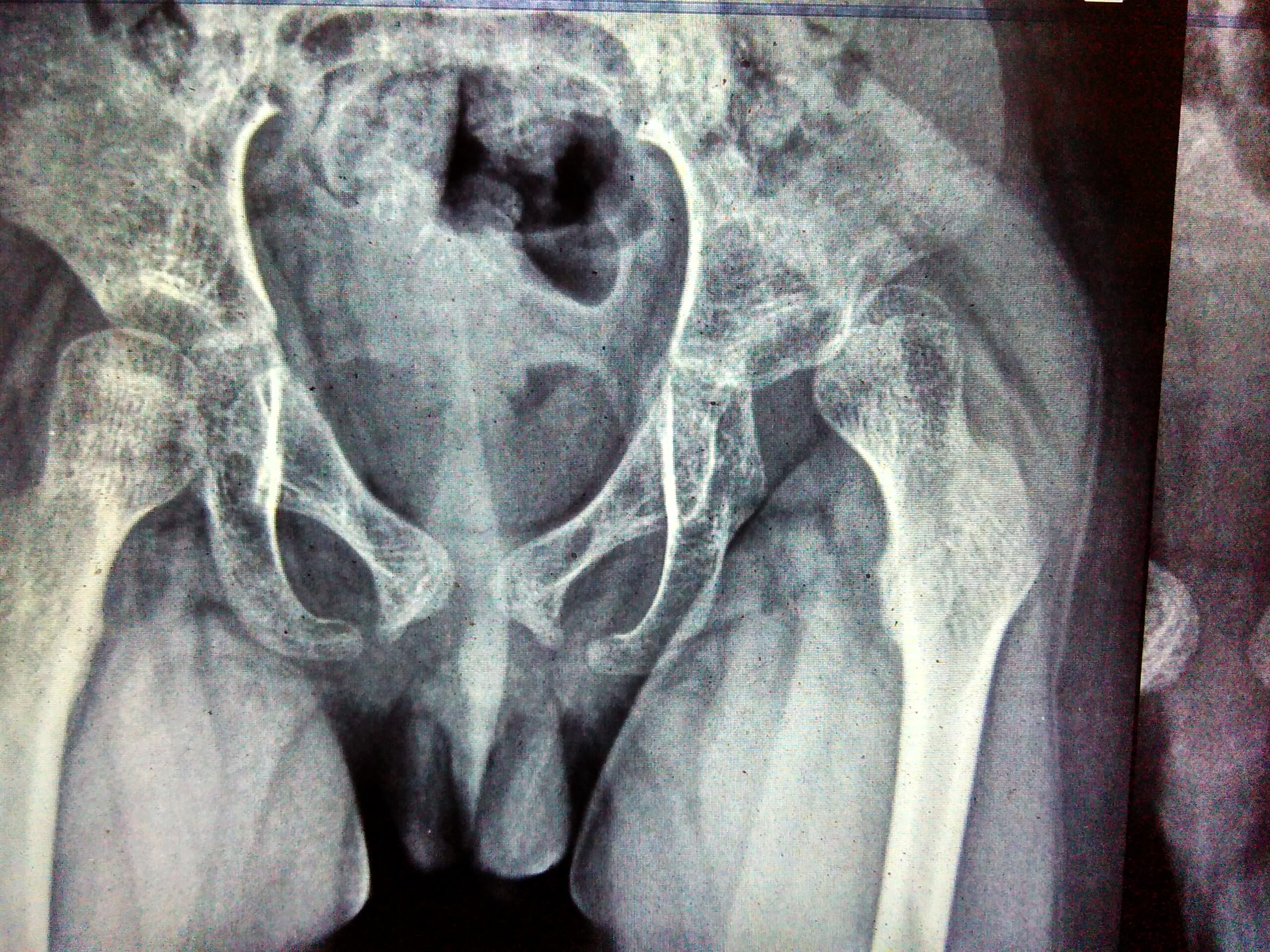
    So we went again, the next day to get another X-Ray done. Of the pelvis this time. And there it was. A clearly dislocated hip, on the technician’s monitor itself. Right there – first glance.

    That put us on a round of doctors and tests and the long story made short is we are admitting him to Surya Hospital tomorrow and he will undergo a four to five hour surgery on Thursday morning to fix his hip. The doctor said he will try a closed reduction first (manipulating the joint back into place under general anesthesia, but without surgery). If that doesn’t work, he will do an open reduction (surgery to bring joint into correct position). If that succeeds, well and good. But there may be abnormal growth of the thigh bone preventing it, in which case he will need a femoral osteotomy as well and a pelvic osteotomy if the socket in the pelvis where the ball of the joint on the femur should fit is not shaped correctly to receive it. So a minimum of one and maximum of three procedures will be done on him on Thursday.

    After the surgery, he will be placed in a spica cast which will immobilize his hips and legs in the correct position (rather like riding a horse) to hold the joint stable so that it heals in the correct position.

    That is what is going on. It is scary thinking of him undergoing surgery (I don’t really trust doctors after our experiences with him, plus he is so small), but I am convinced his hip needs to return to correct position so that he can use it to balance himself and sit at least, if not walk. It will hopefully prevent long term pain and deterioration of his hip. So while scary, I am convinced it is necessary and a part of me is relieved that we found out what the problem was so that it can be fixed.

    That is where we are. Nisarga is completely normal at this point. He doesn’t know a better hip, so all is routine with him. Remains to be seen how he takes the surgery. I am still hoping on that tiny chance, near negligible, that the closed reduction will work and he will escape surgery, but if he doesn’t, I know that even with surgery, the hip getting fixed will hopefully allow him to use his hip better.

    Let us see. Whatever it is, life goes on, and we have come through much together, and we will continue to face things together.

  • The vaccination debate

    The vaccination debate

    It is one of those times when the vaccination debate seems to be raging on social media. As a parent with a disabled child, I have my concerns and fears about vaccines, particularly since the onset of Nisarga’s disabilities happened a few days after his vaccination.

    I don’t go around telling people to vaccinate or not vaccinate. I frankly don’t know if his disability is because of the vaccination or because of something else that coincided with it, but I didn’t notice. And because I cannot be certain of that, I don’t go around telling people not to vaccinate.

    On the other side, the complete certainty with which pro-vaccine people push their agenda as the whole and complete truth turns science into a religious faith.

    What science knows is constantly updating. Things thought safe earlier are considered unsafe later (cigarettes). Things thought to be dangerous earlier turn out to be safe (coconut oil or butter for cooking). These are just two random examples out of many. The idea that science knows all there is to know about vaccines is unscientific. At the same time, calling vaccines unsafe because anecdotal data ‘could’ be proved right one day is equally unscientific. All we have to go with is research data that currently declares vaccines safe.

    This data is not without its problems. Here are some problems I faced in ruling out vaccines as the cause of my son’s disability.

    There are no reports of your son’s symptom associated with this vaccine

    This is a common reply I got. Yet, of dozens of doctors we have seen over the years, not a single one took details to report the onset of symptoms my son faced. Leads me to wonder how many cases are not reported because “there are no reports”. A sort of self perpetuating religious belief.

    There is no way to rule out vaccine damage

    I have asked doctors over and over if there is a test or something that can rule out vaccine damage. There isn’t. So one wonders where the certainty comes from.

    If it merely comes from research, but the system ignores parents actually reporting symptoms developing in their child, how reliable is the research as the final word?

    Quality of vaccine

    In India, where spurious drugs are hardly big news, and even the government has been known to purchase from suppliers with known problems in quality standards, the research findings are rendered irrelevant, because the actual vaccines administered can still be extremely problematic. Even properly stored vaccines can develop problems in a country where remoteness and lack of adequate standards can result in sub-standard storage or contamination. Therefore the claim of “completely safe” is not just absurd, it is potentially dangerous.

    Lack of information that isn’t pushing agendas

    There is an abundance of information on the claimed safety of vaccines and claimed risks of vaccines, but there is very little information that isn’t trying to promote a conclusion. It leaves parents uncertain about making an informed choice.

    My view

    I have my suspicions about the medical industry as a whole and have seen too much to believe that it puts the health of people first. At the same time, I don’t have the knowledge or resources to research vaccines independently to make a decision I can trust. I am certain that some vaccines do work and do save lives and protect against illnesses far more dangerous than the risks.

    If I were to have another child, rather than avoiding vaccines completely or embracing them completely, I would select key ones to give based on incidence of the disease in our region, danger of the illness protected against to the life and long term health of the child, and frequency of reported harm from informal anecdotal routes. I would additionally recommend parents, particularly in India to go the extra mile to ensure that other potential causes of risk can be reasonably ruled out – purchasing from reliable sources, checking expiry and so on.

    It would be nice if the doctors honestly recorded parents reporting reactions in children after vaccination instead of saying “oh, it doesn’t happen, there is no record of it (because we don’t record it?)”. It would give parents real information to make an informed choice instead of having to rely on cherry picked information from either side.

    It also needs to be remembered that the chances of the vaccine preventing the disease it claims to prevent are higher than the chances of adverse effects, so vaccines for life threatening diseases prevalent in my region may not be such a bad gamble – even if vaccines came with some risk. Would I give my child a small pox vaccine if reports of cases in my region emerged? Damn right I would. Would I vaccinate him for Hepatitis B – which is primarily contacted through bodily fluids, infected syringes or sex – if I was clear at time of birth? Probably not. Particularly since the protection would not last till the time they came of age to be sexually active. If my child were sick and needing surgical procedures or frequent injections or be in places where infection from urine of other people, etc would be a risk? I would consider it. Would I give it to him if I were in some rural place with dubious medical services (like most of India)? Probably not. Would I vaccinate my child for chicken pox or the flu? Nope. Cervical cancer vaccine? Never. Heard too much pushing from profiteers (who conveniently fail to mention is doesn’t protect against all types) and too many stories of harm. How many people get cervical cancer anyway in a currently barely vaccinated population?

    My last thoughts on this subject is that there is a need to stop reducing science to blind faith and provide the masses with enough data of reports and research and questions raised that they can make an informed choice. There is also a need to stop treating vaccines like one monolith as though they are all equally effective and equally necessary and that people owe it to humanity to inject each and every one into their child.

    There is a need to elevate thinking on this issue and that cannot happen if supposedly educated people create “scientific” superstitions around vaccines.

  • New beginnings

    New beginnings

    We have now moved to our new home, and Nisarga seems to be thriving. He is eating more, sleeping sooner, sleeping sounder and rising at the crack of dawn all excited.

    Another new beginning is the end of my resistance to massage. After being told that it wouldn’t help him, and after seeing little to no result from it as well, I’d given up on it as one of those things everyone either tells a mother to try or avoid, depending on which end of the orthodox to allopathic spectrum they land.

    Then today, something a new neighbour said, suddenly clicked. He was speaking of trying various exotic oils specifically to help his condition (as opposed to the general “build strength” or “good for baby” suggestions so far). It was a minor departure from the routine suggestions and possibly an accident more than intentionally different, but it got me thinking.

    After Nisarga settled into a very uneasy sleep, I got on the internet and hunted down information.

    And I can’t believe I missed this, but 3 in 4 cerebral palsy patients experience pain from their constant involuntary movements. Astonishingly, I have not actually tried to solve the pain beyond gently pressing his feet when they seem restless. I however seem to have noticed subconsciously that the few times he was given crocin – usually for unrelated reasons, he slept soundly and moved around less in his seep. Obviously, he can’t make painkillers a part of his diet, but surely there can be massage oils for pain that can be in his routine?

    So I hunted down information that mostly led me to herbal and alternative medicine websites and some natural treatment websites including one that claims to treat cerebral palsy (implying cure). In the process, I ran into dozens of names of oils and herbs that would be useful, and made a note.

    Among those on various pages (and for various related reasons ranging from pain relief to relaxation and nerve stimulation), I noted those I had present at home to experiment. I had rosemary, eucalyptus and citronella (I thought it would be the same or substitutable, if not, for lemongrass). On a stray note, most of these seem to be astringent or somewhat mildly irritating to the skin – I wonder if that is a factor in the pain relief – by creating counter sensations or increasing blood flow, etc.

    Taking a few spoons of olive oil, I mixed a few drops each of these, and rubbed a sleeping Nisarga’s legs.

    Normally, touching his legs when he’s sleeping, particularly extensive touching causes him to contract them closer to his body. Not today. He just relaxed into my touch, his breathing suddenly deeper and his whole body went limp in a way that spoke of relief.

    So I rubbed some into my own aching legs, and the ache indeed seems better.

    So now I’m hunting down various other alternative medicines and massage oils to try with Nisarga. Might as well boost this growth spurt and see where it takes us.

    And I am planning to massage him (very lightly) with one or more of these oils twice a day. Less rubbing and more of pain relief and relaxation.

    I’ll update here if there are any noteworthy results.

  • Another day at the hospital

    Another day at the hospital

    Another Wednesday, another trip to the hospital. Our first since the big Cerebral Palsy clinic day, which had gone far less dramatic than we had been hyped up to believe.

    On the positive side, the session for speech therapy went well, with the therapist giving us several ideas on encouraging speech that ranged from toy choices and interaction styles to massage of his cheeks and mouth area. Lots of ideas with potential.

    The time spent in Room 106 with its various balancing apparatus was very useful again, like last time. We tried out a few more pieces of equipment including a rocking horse kind of thing, which Nisarga enjoyed tremendously.

    The two physiotherapy departments continue to be a pain. We have been prescribed certain exercises for him, that we must make him do, but Nisarga remains true to his history of not liking repetitive and regimented movement as well as becoming stiffer after doing it. Frankly, I agree with him, as logically, they do not appear to be headed in a direction that will contribute to his movement choices. I don’t anticipate much good to be resulting from these and am, in fact having to work harder to combat increased rigidity, both in him, and in my mind, as forcing a crying child to do exercises he is trying to escape just does not fit my view of humane.

    I also think it is dangerous, as crying is the only way he can indicate if he is in pain or other discomfort, so it may be possible to injure him by forcing him to do something he is resisting with everything he has in him. And he is not like that. Nisarga is one cooperative and cheerful guy. Uncontrolled crying is so not him at all. So I am very disturbed by these therapy sessions, particularly the one on the first floor, where the therapist is extremely uncompromising in the movements she wants him to make and Nisarga dislikes that so much that he simply refuses to have anything to do with her.

    I need to find a way to select the therapies that are helping and opt out of the ones that aren’t, in order to maximise the useful impact on him, and reduce stuff that wastes his energy with stress or adds resistance to an already difficult reality. Or at least ask the therapists to not force him and simply show us the movements, which I can try and weave into our Feldenkrais sessions. This is not going to be easy, as the husband is usually inclined to think I am a fool and don’t care about Nisarga’s well being and etc, so apart from resisting the considerable pressure from doctors to “do this if you want your son to get well”, there is the home front too. Why would I be happy to cooperate with one therapy and not another? What vendetta would I have for some therapists over others when they are all new to me? If I was resisting for the sake of it, I’d do it for the whole gig and save time traveling 4 hours every Wednesday in insane rush, no? Procrastinating. Who knows, maybe against the odds, the exercises help and I don’t have to do this battle?

    Anyway, I am noting the movements those therapists see as desirable and trying to achieve them in more respectful ways at home. Hopefully that will help. Or at least not harm.

    In other good news, the medicine Nisarga had been prescribed at the Cerebral Palsy clinic had been very difficult to find, and we had almost given up, when a short tempered nurse told (an even more short tempered) Raka something that led to me suggesting yet another attempt to find it. While Nisarga and I had a great time in the room with the balance equipment, Raka went out searching for it again and chanced to find some lane of medical wholesalers, where he finally got the medicine.

    This is very good, as my internet searches had shown me that it helps decrease spasms, which is very urgent for Nisarga, as he is not able to do a lot of actions he knows how to do, simply because of involuntary movements fouling everything. If the medicine helps dial the spasms down, that one chance search in some godforsaken lane will probably do more to help him than 10 therapists.

    Yeah, so that is that. So far, so good.

    Enhanced by Zemanta
  • Vaccine damage – fact or fiction?

    It is one of those days. I’m looking at old photos and videos of Nisarga and the difference is so stark to me. Yet all these years, doctor after doctor has dismissed vaccine damage as a possibility. I cannot understand this. If a child has changed dramatically within days of being vaccinated, how can it be discarded so easily?

    Worse, say the doctors are all knowing and know everything there could possibly be to know about what vaccines can and cannot do, with the kind of scandals around medicines with severe quality control issues to the point where some claim that over half the drugs being produced in India are of lower quality than claimed, how can ANYONE dismiss the possibility so totally and without investigation?

    I go nuts every time I think of this. What has happened with Nisarga has happened, but surely more children need not go this way? Yet I feel impotent. In all these years, not a single doctor has noted the symptoms to report a possible vaccine reaction.

    I realize that I have been very ignorant and lax in terms of tracking changes, but to the best of my memory, this is what happened. Nisarga got vaccinated for DPT and HiB and I don’t know which one it was, but he became what I understood as lethargic. By the time I realized something was really wrong, it was a good few months gone by. It was nothing dramatic, just less and less activity and by the time I realized that he could no longer do the things he used to be able to and was not just in a low activity phase….

    He had been physically mobile since birth. He used to kick his feet in the air, wave his arms about from the beginning. Just before the vaccination, he had rolled over for the first time. While I don’t have a date by date track, for proof that I’m not imagining things, this is Nisarga at a week old. Note how his arms and legs both move against gravity freely, though he was born underweight and is rather scrawny. He rolled over to his sides in the process – this is him at one week old. He still cannot turn to his side this rapidly now at 4 years old. The strange expressions are because he was pooping at that time. He still makes strange faces while pooping 😀

    This is him at 2.5 months old. His weight is slightly better. Again notice how he has no problems waving his arms, though his feet are not so visible in this one.

    This one was shot soon after the vaccination. I don’t remember the exact date, but I hadn’t realized anything was wrong. Just thought he was content to watch instead of grab the rattle. Notice how his arms are spread wide and unmoving. It was over a month before he started using them again, and improvements were very, very gradual and with a lot of hard work getting him to learn. He was able to clap his hands reliably at 3 years old. It is today that he was able to hand a toy into my hand for the first time. He is 4 years old.

    This is a month or so after that video. Notice how his arms and legs barely clear the ground in spite of him being so excited and laughing (which makes it easier to bring hands and feet closer to body).

    If this does not deserve doctors even taking serious note of symptoms reported, I don’t know what the hell does.

    Enhanced by Zemanta
  • Fun at the AIIPMR

    Fun at the AIIPMR

    These are two activities at the AIIPMR that really helped Nisarga. He enjoyed doing them, and he was helped by them. In contrast, yesterday’s manipulations with his foot have left him with those stiff legs I was hoping we could leave in the past…

    Tracking the impact of various elements of therapy on him, so we can choose the more useful with time. Anyway, enjoy these pics 😀

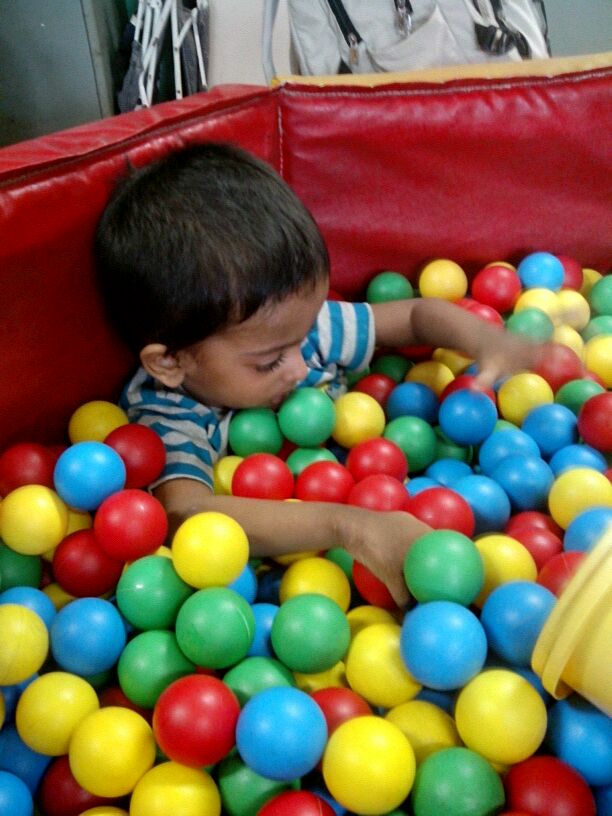
    This is a foam tank full of spongy balls.


    They put Nisarga in this tank of balls and he was happy like a fish in water. The balls seem to provide slight support as well as sort of suspend him so that he is free to take the posture he is most comfortable in, regardless of gravity. He was picking up the balls one by one and throwing them into the bucket.

    IMG-20131006-WA0003


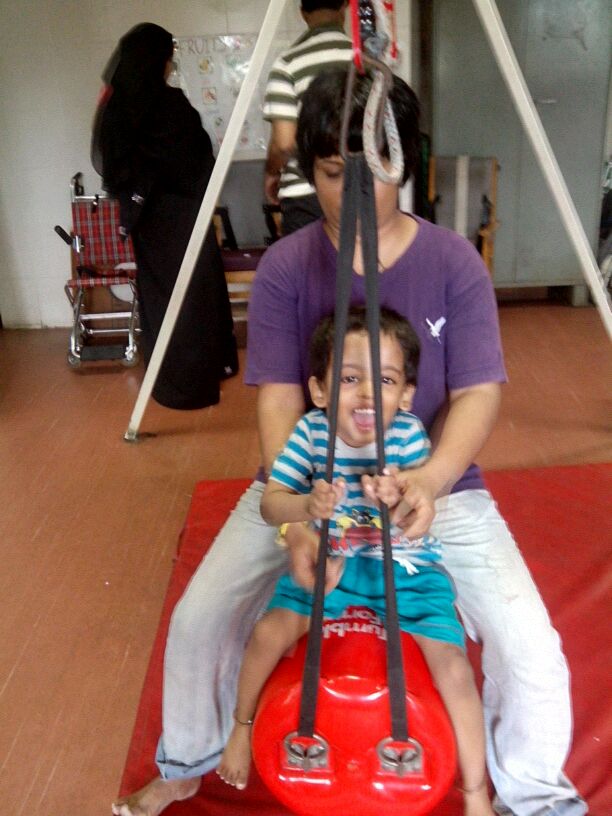
    This was another very useful activity, where he was made to sit straddled on this suspended roller and the roller was swung gently. I imagine it helps with trunk control, since at least that is what I could feel his back up to as I supported him. I sneaked in a few Feldenkrais touches and movements and I found him responding really well. The changes lasted well after the session, for a couple of days at least.

    Enhanced by Zemanta
  • Amazing day at the hospital

    Over the years, I have become rather cynical of the medical fraternity. The cincher was when my son progressed rapidly after stopping mediations he’d been taking or two years. As far as Nisarga’s story is concerned, doctors have proved about as useful as your average tantrik wanting to slaughter two pigeons as a cure.

    At the same time, my limited knowledge is not adequate to help my son, so doctors it must be, over and over, and it is looking like we hit pay dirt this time.

    This was unlike any doctor visit so far. This is the All India Institute of Physical Medicine and Rehabilitation. A mouthful, whether you say it straight of abbreviate it. In fact, we got recommended this place several times, as “hospital in Mahalaxmi” No one mentioned the name. 😀 Not sure most patients know the name though it is written right up there on the gate, then the entrance of the building and every paper you touch.

    We reached early and were given a slip to fill in patient details. That slip had a number on it. Bye bye long irritating queues waiting well before counters open. Already a good day, and the hospital wasn’t even open for business yet. Turned out there was no business. There was no charge at all. Not even the Rs.. 10 for the case paper you find in Wadia (along with rude staff).

    We met a doctor who took a case history, and began with saying upfront that this looks like Cerebral Palsy, though it is difficult to confirm. A terrible diagnosis of sorts, but given that we had anticipated this for a long time, a most welcome one. At least you can fight the demon you can identify. And the consultation just got better and better. Half an hour later, we were out of the office with recommendation to attend a CP clinic, measure Nisarga for a cerebral palsy chair and a string of numbers – rooms on various floors to “go and get their signature”. A breeze, we imagined. Famous last words.

    Those numbers were actually various therapy rooms. We discovered that Nisarga would be assessed by the doctors in EACH DEPARTMENT and he would have appointments with each department for therapy. The first department we went to was for assessing development (or something) and a very patient doctor listened us through (It is unbelievable – this is one hospital where doctors have all the time their patients need. Makes you want to weep just feeling that) added two more numbers to the list. The second department was for developmental therapy. It looked like an occupational therapy room with all sorts of bright toys and stuff. Alas, by this time, Nisarga was so exhausted, that te doctor could not assess him properly and asked us to bring him back before they would sign that paper. We were asked to commit to one day a week to bring him to that department. We chose Wednesday.

    The appointment for the Cerebral Palsy clinic is on the 3rd October, and we will have to have got the signatures of all the departments before that date. I think the idea is that they will nail Nisarga’s developmental status on various fronts thoroughly before the CP clinic. In other words, the next two Wednesdays are going to be like this one.

    We are tired. There was a lot of waiting and Nisarga seems to have grown absurdly heavy since the last time we did this. No choice but to take a pram along the next time – which is a whole different headache when it comes to boarding the notorious Virar locals in rush hour. Making a habit out of this is going to be draining. To put it mildly. Nisarga is not the easiest kid to lug around. Perhaps I can arrange for some friends to help out. Need to plan.

    But the good part is that we have a diagnosis, however tentative. We have a direction, we have all the expert help we need and for free. The expert help is thorough, it is polite and it is efficient (in spite of the long waits of busy practice).

    A part of me wonders if constantly being around special needs kids and amputees and people coping with or recovering from severe injuries has a way of making people more caring. The staff here did not jangle a single nerve in spite of the long and exhausting day. This is a plus if we will be seeing their faces every week.

    The most optimistic part of the day was that no children in the therapy room were being tortured (Have traumatic memories of kids being bullied and slapped to achieve things at the earlier experience with physiotherapy). The only kid crying was my son, and he wasn’t receiving therapy. This goes a long way toward reassuring me that maybe this will work.

    The bonus? The canteen is brilliant. Good food, friendly people and very very helpful to accommodate any… special needs.

    I am tired till my eyes are crossing, but I’m also buzzed with hope. I’m telling myself that this isn’t the first time I’ve returned from a medical establishment all infatuated and to dial it down, but to no avail. I want this to work.

  • Feldenkrais method for kids: Sitting straighter, using hands more

    Feldenkrais method for kids: Sitting straighter, using hands more

    Posture Analysis:

    Nisarga’s development seemed stuck with him sitting hunched, braced against his hands or rather the back of his hands. Looking at some videos of using the Feldenkrais Method with kids and reading and mimicking his posture, I realized that this too is a manifestation of him not using his lower back. His knees turn inward as well and muscle tension is a constant to overcome for most movements. He was not comfortable sleeping on his back, though he is able to sleep on his back easily now after some work I did last month. When crawling, his legs stick straight out and stiff without movement. There is very little self awareness that can be leveraged to help him differentiate these movements enough to alter habitual patterns.

    Nisarga W-sitting

    His hands are often clenched and he avoids touch on the palm of his hands, preferring to use the back of his hands to push against the floor. Similarly, he avoids contact with the soles of his feet, lifting his legs if you try to stand him up or not bearing any weight on them. There is hardly any muscle tone. Recent sessions have allowed him to be comfortable resting them on the floor while in a rocking chair or walker, without putting weight on them.

    In terms of posture analysis, he is often like a diver in the middle of a somersault. Upper body curved, legs tight together, straight out at an angle. Except he also hunches his shoulders in and his legs turn inward as well.

    The Feldenkrais Method resources I found useful for this:

    It was easier said than done, but three consecutive movement therapy lessons based on functional integration movements from Yochanan Ryewerant’s book “The Feldenkrais Method: Teaching by Handling” have shown small but definite improvements. I also got many practical ideas from Michelle Turner’s excellent video series on Functional Integration lessons with children using the Feldenkrais Method.

    The Feldenkrais Method Functional Integration movements I did:

    Self awareness is half the battle. In various functional integration movements, I helped him learn to move his pelvis to support his lower back better, resulting in an immediate straightening of his spine while his lower back was engaged. Particularly useful was gently rocking his pelvis forward while he played and touching the top of his head so he had some self awareness how he became taller as his back straightened. Rounding his back by pushing lightly from his lower chest and then straightening it by pressing lightly on his lower back.

    I did another variation of this with him lying on his side, which really seemed to register on his self awareness as it is not a movement we do normally and he did not have to worry about bearing weight or balance. Additionally, and possibly unrelated, I worked with very gentle movements of his toes till his legs started relaxing more. I think the muscle tension in his whole body relaxed and there was more ease, but it was not such an immediately observable change for whole body.

    I was not able to video shoot these functional integration lessons, because I don’t have anyone assisting me and also because he becomes instantly distracted by a camera. I have never been able to set it up without him noticing.

    He still forgets to sit straight, but now that he can, if he wants to, he is able to do a lot more movements than before. All of a sudden. Adding something new with each session.

    The Results

    He still uses his hands for balance, but is sitting up more often and also uses his hands for balance more often than bearing his weight. He has started rocking back and forth while sitting in a W-sit. He has started enjoying being rocked side to side (shifting weight from one buttock to the other) if done in rhythm with music. He has started using the palms of his hands more often than the back of his hand, which was usual up to this series of functional integration lessons.

    He used to grab my hair to pull my head down to plant kisses on it all the time. He loves it. So I have started not bending when he pulls and letting him come up to me instead. He has started pulling himself up on his knees if he can get a fistful of my hair (it hurts, but considering that it is one of the very few things he grabs strongly and willingly, I am glad he does it). His back is not strong enough to do it well yet, but once in a while he surprises himself by standing on his knees. Grin, kiss, fall back into a sit. This is something he had started briefly last month, but is able to do it slightly better after these sessions.

    He has started babbling a lot more and using his hands more readily.

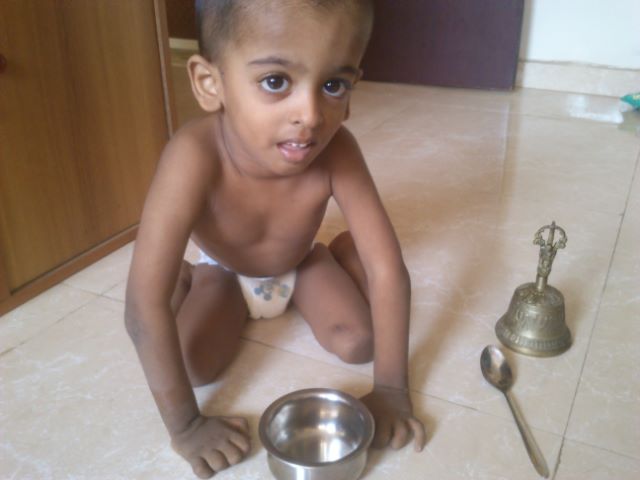
    He is also showing definite improvements with how he uses his hands. He takes out a spoon from a bowl, and then puts it back in. Gave him a rounded pot with a deep dish that fits in the mouth like a cover and he played with it in a variety of ways putting one on top of the other, putting on as lid, taking off, putting my mobile phone in the pot and putting on the “lid”… All this is new and has managed to alter habitual patterns of immediately releasing anything he grasped. All of a sudden he seems to be discovering a wide range of possibilities to try out. I believe this too is a direct result of his hands being easier to free now that he doesn’t use them as much for bearing weight.

    There is a new self awareness that has him pausing and taking stock when confronted with something new as though evaluating potential before engaging.

    His is normally constipated, but in last three days his bowel movements have been fine. Though this may be related or a coincidence.

    All in all, an exciting time and for the first time, I am experiencing that I am actually able to help him to learn movement. Strikes me anew just how much I need to learn. At the moment, it is better than last year, but many sessions don’t seem to strike any note with him. I see this as a direct result of me lacking the knowledge to choose movements that will help him. In the last few months, my skill has improved, and it is helping him dramatically.

    Note: Parents in India often ask me if I will help their child. I will, but please note that I am a self learned practitioner and am not a better option than finding a real one, which may be near impossible in India, but possible if you go abroad. Also note that I will not be able to travel to your home for it. You will have to come here, though you are welcome to come and even stay for a few days if you find it useful.

  • OPD at Wadia Pediatric Hospital

    Unable to get an appointment with Dr. Anaita Hegde soon, and unwilling to wait further after having spent so much time with lack of money, depression, domestic issues, etc we decided to go to the OPD at Wadia hospital where she consults on Fridays.

    Was a surprisingly inexpensive affair and straightforward if hideously time consuming.

    Rs.20 doesn’t even come close to the Rs.800/- we paid for the previous visit, so this is far more affordable as well.

    On the train, it was mind numbingly crowded and Nisarga hated it, which meant it was nerve wracking for me. Finally about half way of the hour long journey done, we got a seat from some good Samaritan who had seen us struggling for over half an hour.

    That didn’t work. Sitting with a wall of strangers packed in his face was the last straw, and Nisarga wailed and fumed till I stood up again. Somehow, we managed and got to the Wadia Children’s Hospital.

    Knowing we would be late, Raka called up my father and asked him to file the case papers. I could have told him then and there it would be no use. Dad simply isn’t that kind of person. He insisted that without Nisarga’s medical papers, they wouldn’t make his case papers – which is the biggest load of bull shit, but then that is my father for you. He believes whatever he decides to believe.

    But he decided to come anyway, so the train journey was also about fielding calls from him reminding us repeatedly about things like which station to get off, name of hospital, where can we get a taxi, etc till I simply stopped taking his calls.

    Finally, we met at Wadia, and of course, he hadn’t filed the case papers, so I stood in the queue and did it. No. They didn’t ask for his medical history.

    I peeked at his register, and saw that our name was third on it. This looked good. We could be in and out of there fast. Famous last words.

    We were asked to wait in a massive hall with many, many people in it. Kids everywhere. My dad started nagging for us to eat – as though this was a picnic! So we took turns eating. I went first, since it was unlikely we’d be called immediately and I should be ready to go when our turn came. My father came with me and made sure I ate. I suppose it is caring, but I was too wired for food, honestly.

    As things turned out, it was a very good idea.

    Our turn came, and a very rude ward boy yelled out Nisarga’s name. My father was walking him around, and it took him a while to get there and the man just yelled at us and then bullied us to a room where many doctors were sitting on one side of bed/tables with one stool each on the opposite side.

    None of them were Dr. Anaita Hegde, whom we were supposed to meet, so I told him that, and he yelled at us again to just do as we were told. Total concentration camp scene.

    Various doctors were in various stages of consultation with various patients and we found one who was free – like a cafeteria table He took Nisarga’s case history in meticulous detail. I told him to refer to the old papers and take only the remaining info, but that wouldn’t do. So we talked, and talked and talked. I started ADHDing out and probably rushed the info, but he kept bringing me back to each stage – even when there was nothing more to say about it.

    I understood that these doctors were some kind of trainees working under Dr. Anaita Hegde, since she is in high demand, and the OPD is impossibly full of people for one person.

    He kept our papers and told us to wait and that he would call us when the she arrived. It sounded like such a quick thing… she’ll arrive any time now, and then we’ll show her your papers.

    In reality, EVERY patient in that hall met her or another doctor who was there with her – the doctors we had met literally ushered people to and back and detailed out her instructions in case we didn’t understand, etc. The initial visit with the doctors was to streamline everything so that her time is not wasted.

    Our turn came, and we stood inside the door waiting for the previous patient (who had just started their consultation) to finish. THIS was such a piteous sight. It was a plump boy about ten years old or so. I don’t know what exactly his problem was, but he walked stiffly, and made noises rather than spoke and was hating this whole experience thoroughly. He had been on the table next to ours when we consulted the junior doctors.

    Then we had seen him resisting entering the doctor’s room before us, digging his feet and refusing. His father physically lifted him and took him in kicking and screaming.

    This time, he was sitting on the floor, hanging on to various bags, crying, pleading with his parents for something. The hassled parents were ignoring him, using this opportunity to speak with the doctor rather than their son. And he was such a piteous sight. He was crying for twenty minutes, sitting on the floor, offering bags, banging them on the floor, begging for attention. And I hate myself for not going and sitting next to him to give company.

    I didn’t want to interfere in such an important consultation, and the parents had a very resigned, been there, done that kind of look. I kind of understood them too – this was an important thing for their son’s health with a rarely available and excellent doctor, but it made me angry that they both ignored him – surely one could pay attention to their son?

    It made me appreciate both my father and husband more where they always trust me completely to talk with doctors when they come along and support by paying as much attention as Nisarga needed so that he didn’t either disturb the consultation or feel neglected.

    While this pretty much stems from no one having taken enough of a stake in Nisarga’s care to talk knowledgably, it also was a big plus that they recognize it and support how they can when needed. No such thing as absolute good or bad.

    The actual meeting with Dr. Hegde was amazing. Since we were standing in wait for a long while as she dealt with another patient (and all the doctors were also in one common room/hall), I had a chance to observe her work.

    How different she was from the last visit with her in that Air-conditioned room and fancy facilities. I actually liked her better. She was working at top speed. Listening, examining, speaking with parents, really listening to them, advising, addressing concerns, giving directions in undertones to the assistant doctors…. whoa!!!!

    Gone was that sophisticated, made up hi-tech doctor and here was a person doctor. Seriously amazing. And far more beautiful with stray hair slipping the clips and a lot of straight talk with colleagues, etc than the very formal earlier meeting. I could imagine her anywhere in India, dealing with anyone with respect. Decided then and there, regardless that it was cheaper, I wanted to consult with this person and I was going to suck it up and do the bloody journey and mind numbing wait (not that the earlier meeting didn’t have a mind numbing wait – only it was in a private clinic).

    She listened carefully, and it sounds like we have a direction. Seems increasingly likely that an imbalance in brain chemicals is causing Nisarga’s difficulties. Writing a separate post on the medical aspects so that it can be referred to easily.

  • OPD with Dr. Anaita Hegde at Wadia – possible diagnosis

    If you remember the previous meeting with Dr. Anaita Hegde, you will recall that I left it feeling that Nisarga was in good hands. His reactions to Syndopa Plus shook me a little, and the physiotherapy seeming counterproductive didn’t help. I later stopped all medication on advice of a family physician.

    Then, when I had money, and I did the tests, I also started the Syndopa again (that post is still in the drafts), so that when I consulted Dr. Anaita Hegde again, she could see the effect – since she had recommended trying it.

    Turned out to be a very good thing in today’s meeting at the OPD at Wadia Children’s Hospital.

    The second time around, Nisarga has been on Syndopa Plus for about a month now, and there have been subtle but constant improvements in how he uses his body. He still doesn’t crawl, but he creeps at full speed now, and uses his legs more, which seems like a precursor. His use of hands has improved significantly. He has started pointing at things, holding things in two fingers, throwing things, banging them… and when he is really upset and crying, he comes up into a W-sitting position on his own – he had lost that.

    There still aren’t changes in terms of milestones, but there is initiative in those directions. He holds his balance much better when put in a sitting position, and the head lag is almost gone. The dystonia is still there, though slightly reduced.

    On the basis of all this, Dr. Hegde thinks that the Syndopa Plus is helping him, and seeing as how he isn’t showing adverse reactions this time (increased body weight?), I should continue that at 1/4th tablet three times a day. She added Bexol today. I am to begin with giving him a quarter tablet thrice a day, increase to half tablet thrice a day in ten days and then full tablet in another ten days.

    She said that the dystonia and not lying on back at all in particular and some other symptoms and tone made her suspect an imbalance in brain chemicals – dopamine in particular. She had suspected that the other tests – opthalmic testing, karyotyping, metabolic screening and BERA would turn out normal, but they were important to rule out, and them being normal makes it even more likely that her hunch was correct.

    The test to confirm this is very expensive and costs about 2 lakh and is done abroad, with spinal fluid from three points on his spine collected and shipped on dry ice – basically testing how impulses are getting transmitted. It is called a neuro-transmitter test. The test is offered for free on a humanitarian basis for people in need, but even the couriering on dry ice, etc costs 9k.

    Also, just because it is free, the generosity shouldn’t be abused and she uses it sparingly so that most people gain, so she first tested her hunch. If the Syndopa caused any improvement at all, and other causes were reasonably ruled out, it made sense that this test would nail things. Now that it seems right, she’d like confirmation by doing that test before committing to a long term treatment plan. That probably was at the root of all the disbelief from all other doctors that Syndopa was prescribed without diagnosis. If this was told clearly, then it would make more sense, and I would probably have continued it all through. But hindsight is 20/20 and best not debated.

    I suppose this is where her formidable reputation as an excellent pediatric neurologist comes in. While most doctors were surprised at the Syndopa, each one told me to continue on the track she had put me on in terms of testing. There was absolutely no doubt in anyone who knew her that she was good, very good. I guess, I have to set aside my suspicion of doctors. Twitter had destroyed it almost anyway

    We have to wait a month or more to do the test, because the last three samples she sent had trouble in the customs in Spain, so she wants that to be sorted before sending more.

    If confirmed, this will mean medication for several years at the very least. At the same time, the medication will not be complicated, and she estimates chances of recovering full function as very likely. We are already tentatively started on this track and any response to the treatment in itself will also be confirmation of her hunch. So this is a very, very good thing. Never have I looked forward to an expensive test so eagerly, nor have I ever hoped for a test to come out positive so much