Blog

  • Beautiful, brilliant day of learning

    I had been getting a bit pushy with Nisarga’s movement lessons. Needless to say, it was counterproductive. He was getting bored rapidly or cranky. I was getting frustrated at the lack of a breakthrough. So yesterday, I decided to back off (long overdue). I spent time reading about the Feldenkrais Method, reminding myself of what I was to do and what not to do. I watched videos on youtube. Returned to our session with a calmer mind, determined to do nothing, till it “happened”.

    And it happened. Boy how it happened!

    In one session, Nisarga learned to say “wawa” with a finger stuck in his mouth while saying “baba” so that his lips didn’t touch. Rapidly, he moved to more fingers, less fingers, stuffing T-shirt in his mouth and…. saying “wawa” erratically, but without anything preventing his lips from meeting and producing “ba” instead. Five minutes later, he was making a “guuuuh guuuuh” sound.

    I stopped while we were ahead, did some work with his back and legs and worked a bit with a “false floor” (another post about this maybe later). Today, as he was sitting straddling me as I lay on my back, he suddenly leaned forward, pushed with his legs and put his upper body weight on my arms (he still lacks strength) and voila! He was standing!!! Heavily supported and very brief, but the movement was there, the shift of weight on his legs, the straightening while pushing.

    I supported his elbows so he could put weight on them and he stood up even straighter. Transferred him to a lousy walker we have (need to get a better one) and with some encouragement and generous assistance, he was trying to pull himself into standing there as well.

    What a transformation from nothing happening yesterday, to everything buzzing today!!!

    And as always, it took me to dial down my hyperactivity, do less, listen more.

    In a brilliant, brilliant mood. Only wish I had someone who could run a camera while these moments were unfolding.


    Enhanced by Zemanta
  • Helping your special needs child move

    Disclaimer: I am not a doctor, any kind of professional related with child development or even very experienced in helping children, but I am able to use the Feldenkrais Method enough to help my son move better and I am learning daily.

    Here is a list of some of my own most important insights that help me the most when helping Nisarga to do something new. I think these are basically good ideas for any and all learning, but they become important with special needs kids, because they have limited energy to waste on things that are not useful. Where possible, I am providing my reasoning for the most common issues I run into when parents contact me for help.

    Warning: Some of these ideas will contradict what your physiotherapist says and I leave it to your judgment to choose what is most useful.

    • The goal: Forget perfection. It is not a useful goal for anyone, let alone a child who doesn’t need the pressure. No one is perfect. I can show how inefficiently your body moves, if you wish to be stuck on this.  What is important is continuous improvement. As long as each piece of learning builds on what was learned before, you’re in the green. Wait. Not so fast. Aim for a very high frequency of learning new things. Every minute is good. Every hour or every day works. Any less than that and you need to do more to help your child. It doesn’t have to be elaborate. It can be something as minor as “beating a new surface makes a new sound”. The key to recognizing this is an “aha” moment. Wide eyes, “Oh!” pause, grin that reflects a world of pride “loo what I did!”. <– this is the goal. Score as many as you can.
    • Nothing is wrong: Let go of the idea of “Wrong”. It is useless. Everything teaches something. Learn to value that. He didn’t “sit wrong”. Sitting in this way is not stable, or leaning like this will topple me. These are important discoveries too. Many results create a library of choice on what to do. Rolling over or waling is like learning t ride a bicycle too. You are able to do it not just by discovering what to do, but what to avoid as well. Celebrate those inputs for learning. The are building toward greater ability.
    • Think sharing more than training: The idea is to build possibilities for your child, not take him through motions or life. A child who cannot do something is not waiting for you to blackmail him or bribe him. He has a greater interest in sitting or standing than your bribe or anger. If you can’t raise your hand above your shoulder, it is no use me telling you I’ll buy you a laptop if you do it or yelling till you do. It is plain lack of support or bad manners. What use is an adult brain with knowledge of the movement if you can’t come up with an easier way for him? So you can’t raise your arm above your head, can you do it if you bend back or to the side? How far can you lift it? What becomes possible with the amount you CAN lift? If lifting hand fully is useful, even lifting hand somewhat is useful too. Find those uses. Let him experience that it is useful to HIM rather than something he can’t do that you expect from him.
    • Make it fun: If you’re acting like you’re saving him from disaster, it will not work. Keep your sense of fun. For example, last week, the doctor tried to teach Nisarga to put his weight on his arms by holding his elbows straight forcefully and holding him in the crawling position. Needless to say, Nisarga, not being able to crawl, did not have the strength or confidence for it, and he cried, and the doctor would have simply overruled him and continued through the crying as something necessary. I didn’t become popular when I stopped her, but two minutes later, I had him in that same position from a different starting position (which he found easier) without holding his elbows. The minute the doctor tried to get involved, he started crying and that was that. The doctor had lost his trust by making the experience unhappy for him.
    • Crying through learning is not learning: Learning is fun. The idea is that the child learns something that he can then do on his own. If the experience is an unhappy one, forcing him to a sitting position will never lead him to WANTING to sit. There’s your war lost over a battle. Even if he can, he will be likely to associate it with something undesirable. Kids are resilient, and will choose opportunities to grow by default, but it is an unnecessary hindrance a child with limited ability does not need. It does not make sense to add unpleasant experiences to be overcome in the way of their growth. No pain no gain is a myth. Science now shows that the damage indicated by the pain needs to be overcome for further progress and over-training SLOWS improvement. Star athletes no longer train to the point of pain. Your child is a star pursuing his peak performance too. Not all that different. It is very easy to over-train, over-tire a child already having difficulties with movement. Take your cues from the child, not prescriptions of what “should” be done.
    • Have variety: This is probably the most important thing, because most physiotherapy will be doing the opposite. Repititions are useless. If he’s experienced one, he’s experienced them all, except for the fatigue, which is not a useful goal. Keep changing things. If he sat up on one way, change something. Change position of hand, position of leg. Elevate his head or legs – does that help? Change direction of sitting. Change speed. Vary, vary, vary. Keep him interested, engaged, watching out for what’s changing and what that will mean. That gives him a library of what to do and what not to do faster than a movement repeated on auto-pilot.
    • Dial it down: The instinct on facing failure is to get frantic, try harder. This is counter-productive. More force into a thing that is not working only makes it more difficult to change. Slow down. Start the movement and return without doing it. Use much less force – you aren’t even planning to complete the movement, just seeing what happens like that. That laid back I’m talking. If something is not happening, back off. Take a look at what is happening without trying to fix it. You need to know what’s happening, to fix it, right? So you tried to make him stand, but he’s not able. So it is okay. Go to your starting position. How is he sitting? If you were sitting like that, would you be able to get up easily? What would you have to do *before* standing up? Is he doing it? What happens if you move him like that without making him do anything at all? Can you move him easily in the manner you would, if you were getting up? If you can’t, forget him being able to. If you can, can you get him to do that tiny initial movement without worrying about the end result? What happens? Is he able to do it? Does he move “wrong” instead? Explore, explore, explore. Forget the standing. Find out what is happening. Help him find out. If this doesn’t work, still don’t get frantic. Do something else altogether that he can do. Return here another time. Remember this: No matter how important the end resulting movement is, in your view, adding energy to something that isn’t working will only fix it in the wrong way. So that is a no-no regardless of whether something else works or not. Just forget it and other ideas will start popping up.

    These, I think are the most important things I learned to do to be able to teach Nisarga effectively. Most of these have been inspired by principles of unschooling, behavioral learning theories/experiences and the Feldenkrais Method (They aren’t all that different – only pragmatic and scientific thinking applied to different aspects). To date, if working with Nisarga runs into failure, it is guaranteed I’m doing one of these wrong, and I have to take a look at myself and consciously stop doing things that hinder progress. Usually just dialing down the hyper-activity in me will help the situation considerably.

    Hope this helps. Me not being expert or having experience talking about this, I’m not sure if it has come across clearly, but I am convinced from all my learning and experiences that all these are excellent ideas that are crucial to adopt to help learning in general and for special needs in particular and the opposite of these ideas is harmful. Feel free to use the comments to start a dialogue.

    Enhanced by Zemanta
  • Living with my son’s Cerebral Palsy

    The last day since that tentative diagnosis of Cerebral Palsy has been surreal. In many ways, nothing has changed. While my husband was very resistant to the idea of a handicapped child, I had long reconciled myself to Nisarga never being “normal” – whatever that is. For me, Nisarga is normal. He is my only child. I have no idea of how else it could be.

    I had expected the diagnosis of Cerebral Palsy for over two years now, since all my efforts to learn the Feldenkrais method to help Nisarga kept coming to ideas used for CP patients to be most useful for us as well. Not to mention that the low tonus in the trunk and curled hands were something I saw daily in my son.

    So, in a way, nothing should have changed really, beyond reconciling to a new and hectic way of life. Yet today feels different.

    He is eating well, sleeping well. I did new movements with him, he was able to push himself back in his walker for the first time today. It is almost as if the diagnosis released us from some kind of limbo we were in. As if I was unconsciously treating Nisarga’s condition as a temporary thing and postponing inconvenient things till he was better. And somehow, realizing that this was it was also a call for action to start living NOW.

    Don’t know if that makes sense, because we are most certainly happy on a daily basis, but today was …. different.

    I feel in me a resolve to not let Nisarga’s increasing weight prevent us from doing things and am actually planning on taking him out on bicycle rides with me. I have been wanting to visit local villages and interview villagers as a part of my interest in grassroots blogging for a long time, which I kept postponing because there was no one to babysit the child and so on. And bam. All of a sudden, today I feel I can take him along with me and we can have fun visiting places and seeing people and learning about them.

    Instant freedom.

    No idea what this mood is, or how long it lasts, but I hope it lasts forever.

    Enhanced by Zemanta
  • Amazing day at the hospital

    Over the years, I have become rather cynical of the medical fraternity. The cincher was when my son progressed rapidly after stopping mediations he’d been taking or two years. As far as Nisarga’s story is concerned, doctors have proved about as useful as your average tantrik wanting to slaughter two pigeons as a cure.

    At the same time, my limited knowledge is not adequate to help my son, so doctors it must be, over and over, and it is looking like we hit pay dirt this time.

    This was unlike any doctor visit so far. This is the All India Institute of Physical Medicine and Rehabilitation. A mouthful, whether you say it straight of abbreviate it. In fact, we got recommended this place several times, as “hospital in Mahalaxmi” No one mentioned the name. 😀 Not sure most patients know the name though it is written right up there on the gate, then the entrance of the building and every paper you touch.

    We reached early and were given a slip to fill in patient details. That slip had a number on it. Bye bye long irritating queues waiting well before counters open. Already a good day, and the hospital wasn’t even open for business yet. Turned out there was no business. There was no charge at all. Not even the Rs.. 10 for the case paper you find in Wadia (along with rude staff).

    We met a doctor who took a case history, and began with saying upfront that this looks like Cerebral Palsy, though it is difficult to confirm. A terrible diagnosis of sorts, but given that we had anticipated this for a long time, a most welcome one. At least you can fight the demon you can identify. And the consultation just got better and better. Half an hour later, we were out of the office with recommendation to attend a CP clinic, measure Nisarga for a cerebral palsy chair and a string of numbers – rooms on various floors to “go and get their signature”. A breeze, we imagined. Famous last words.

    Those numbers were actually various therapy rooms. We discovered that Nisarga would be assessed by the doctors in EACH DEPARTMENT and he would have appointments with each department for therapy. The first department we went to was for assessing development (or something) and a very patient doctor listened us through (It is unbelievable – this is one hospital where doctors have all the time their patients need. Makes you want to weep just feeling that) added two more numbers to the list. The second department was for developmental therapy. It looked like an occupational therapy room with all sorts of bright toys and stuff. Alas, by this time, Nisarga was so exhausted, that te doctor could not assess him properly and asked us to bring him back before they would sign that paper. We were asked to commit to one day a week to bring him to that department. We chose Wednesday.

    The appointment for the Cerebral Palsy clinic is on the 3rd October, and we will have to have got the signatures of all the departments before that date. I think the idea is that they will nail Nisarga’s developmental status on various fronts thoroughly before the CP clinic. In other words, the next two Wednesdays are going to be like this one.

    We are tired. There was a lot of waiting and Nisarga seems to have grown absurdly heavy since the last time we did this. No choice but to take a pram along the next time – which is a whole different headache when it comes to boarding the notorious Virar locals in rush hour. Making a habit out of this is going to be draining. To put it mildly. Nisarga is not the easiest kid to lug around. Perhaps I can arrange for some friends to help out. Need to plan.

    But the good part is that we have a diagnosis, however tentative. We have a direction, we have all the expert help we need and for free. The expert help is thorough, it is polite and it is efficient (in spite of the long waits of busy practice).

    A part of me wonders if constantly being around special needs kids and amputees and people coping with or recovering from severe injuries has a way of making people more caring. The staff here did not jangle a single nerve in spite of the long and exhausting day. This is a plus if we will be seeing their faces every week.

    The most optimistic part of the day was that no children in the therapy room were being tortured (Have traumatic memories of kids being bullied and slapped to achieve things at the earlier experience with physiotherapy). The only kid crying was my son, and he wasn’t receiving therapy. This goes a long way toward reassuring me that maybe this will work.

    The bonus? The canteen is brilliant. Good food, friendly people and very very helpful to accommodate any… special needs.

    I am tired till my eyes are crossing, but I’m also buzzed with hope. I’m telling myself that this isn’t the first time I’ve returned from a medical establishment all infatuated and to dial it down, but to no avail. I want this to work.

  • On the train

    Nisarga. Had an exciting day. Yesterday. Raja took him visiting friends and family who have Ganesh idols in their homes. I joined them in the evening at Raka’s uncle’s place in Malad. He makes his idol at home, from clay. This year he had painted it too.

    image

    Nisarga was all agog, watching proceedings with wide eyed fascination. This was exciting stuff. Slept like a log and woke up at 5 am, still wired. And now here we are. On a train to town, the Mecca or special needs kids specialists. Lost track of hoe many times we have done this chasing new leads to no avail. So far only my ad hoc Feldenkrais lessons seem to have shown any result. That too is quite modest, to pit it mildly. Hope this time turns out better. We desperately need a breakthrough. The doctor’s visits have started feeling no different from fasting all day on a mountaintop and sacrificing chickens. Nisarga’s first sleepover went well. Here’s to hoping today is. Great too.

  • Nisarga’s 4th birthday

    Today is Nisarga’s fourth birthday and it is a day of mixed feelings. On one hand, life is full of affection and small, but real learning. On the other, no matter how much I wish not to measure milestones, it is yet another birthday gone past without Nisarga achieving any dramatic milestones.

    He sits well enough with support, but sitting without support is still far from reliable. He attempts to stand using me (and only me) as support, but it needs so much help that it can’t be called standing. A part of me dreads this day when people will ask about “progress” and my usual descriptors that bring joy will not communicate anything real to them.

    So he understands better, he’s learning things, moving slightly better, taking an interest in the laptop, but what does it mean? Does he sit, stand, read, write? Nope.

    It gets tough to explain what I see as daily changes. Small, but welcome. Perhaps they do not impress one who doesn’t realize that there are also answers like no change, no matter what I tried, or worse, regression. We have been through that too.

    So different is the life to present and so different is the one we life.

    For the world, I’m the mother of a special needs child. At home, I’m just mom and he’s Nisarga and life is pretty amazing actually, if we don’t look at missed deadlines of “normalcy”. We have fun together. We respect each other. He’s developing a distinct personality, which I am quite awed to realize is affectionate and sensitive to others.

    Right now, as I type, it is almost five in the morning, and Nisarga has been up all night, playing. He woke a little past midnight when Raka switched on the TV. Raka is fast asleep now, but after a solid  4 hour sleep, Nisarga was awake “for the day”, so to say. So we played in the middle of the night. We watched videos, did silly things and showered kisses on each other. (Been a long time since last update. Kissing is our favorite activity these days).

    Exhausted, I think he will sleep if I try now. Giving him a few minutes to play with an empty snacks wrapper (he has been fascinated with making plastic crackle since last night) while I capture this moment for his blog. The pre-birthday birthday time, when the world hasn’t yet woken, but hours of celebrating a treasured relationship have already happened.

    PS: In other news, I got him a tricycle for his birthday. He can’t ride it, of course, but he enjoys sitting in it and being pushed around, and I’m hoping it gives him ideas for things he could try doing with his feet.

  • Walk in the stormy breeze

    I had taken Nisarga out on a longer walk yesterday evening. He can be really tough to carry for long periods, so I took him riding piggyback, with a dupatta to hold him like a sling. This is very easy to carry and I did fairly good time with it. The weather was perfect pre-monsoon breezy weather. Nisarga was thrilled to find a cool breeze after so many days of languishing in the heat.

    So we went further ahead. Wandered around. Found spots with better breeze to stand at. Looked at cows, dogs, buffaloes, shops…. Nisarga had kept a constant stream of excited “baa be baa baa” and didn’t want to come home at all.

    So we drank some juice. He can’t drink well from the glass mugs the chap uses, so he got sticky. I got sticky and then it was really time to get home and clean up 😀

    Small joys. Today.

  • Feldenkrais method for kids: Sitting straighter, using hands more

    Feldenkrais method for kids: Sitting straighter, using hands more

    Posture Analysis:

    Nisarga’s development seemed stuck with him sitting hunched, braced against his hands or rather the back of his hands. Looking at some videos of using the Feldenkrais Method with kids and reading and mimicking his posture, I realized that this too is a manifestation of him not using his lower back. His knees turn inward as well and muscle tension is a constant to overcome for most movements. He was not comfortable sleeping on his back, though he is able to sleep on his back easily now after some work I did last month. When crawling, his legs stick straight out and stiff without movement. There is very little self awareness that can be leveraged to help him differentiate these movements enough to alter habitual patterns.

    Nisarga W-sitting

    His hands are often clenched and he avoids touch on the palm of his hands, preferring to use the back of his hands to push against the floor. Similarly, he avoids contact with the soles of his feet, lifting his legs if you try to stand him up or not bearing any weight on them. There is hardly any muscle tone. Recent sessions have allowed him to be comfortable resting them on the floor while in a rocking chair or walker, without putting weight on them.

    In terms of posture analysis, he is often like a diver in the middle of a somersault. Upper body curved, legs tight together, straight out at an angle. Except he also hunches his shoulders in and his legs turn inward as well.

    The Feldenkrais Method resources I found useful for this:

    It was easier said than done, but three consecutive movement therapy lessons based on functional integration movements from Yochanan Ryewerant’s book “The Feldenkrais Method: Teaching by Handling” have shown small but definite improvements. I also got many practical ideas from Michelle Turner’s excellent video series on Functional Integration lessons with children using the Feldenkrais Method.

    The Feldenkrais Method Functional Integration movements I did:

    Self awareness is half the battle. In various functional integration movements, I helped him learn to move his pelvis to support his lower back better, resulting in an immediate straightening of his spine while his lower back was engaged. Particularly useful was gently rocking his pelvis forward while he played and touching the top of his head so he had some self awareness how he became taller as his back straightened. Rounding his back by pushing lightly from his lower chest and then straightening it by pressing lightly on his lower back.

    I did another variation of this with him lying on his side, which really seemed to register on his self awareness as it is not a movement we do normally and he did not have to worry about bearing weight or balance. Additionally, and possibly unrelated, I worked with very gentle movements of his toes till his legs started relaxing more. I think the muscle tension in his whole body relaxed and there was more ease, but it was not such an immediately observable change for whole body.

    I was not able to video shoot these functional integration lessons, because I don’t have anyone assisting me and also because he becomes instantly distracted by a camera. I have never been able to set it up without him noticing.

    He still forgets to sit straight, but now that he can, if he wants to, he is able to do a lot more movements than before. All of a sudden. Adding something new with each session.

    The Results

    He still uses his hands for balance, but is sitting up more often and also uses his hands for balance more often than bearing his weight. He has started rocking back and forth while sitting in a W-sit. He has started enjoying being rocked side to side (shifting weight from one buttock to the other) if done in rhythm with music. He has started using the palms of his hands more often than the back of his hand, which was usual up to this series of functional integration lessons.

    He used to grab my hair to pull my head down to plant kisses on it all the time. He loves it. So I have started not bending when he pulls and letting him come up to me instead. He has started pulling himself up on his knees if he can get a fistful of my hair (it hurts, but considering that it is one of the very few things he grabs strongly and willingly, I am glad he does it). His back is not strong enough to do it well yet, but once in a while he surprises himself by standing on his knees. Grin, kiss, fall back into a sit. This is something he had started briefly last month, but is able to do it slightly better after these sessions.

    He has started babbling a lot more and using his hands more readily.

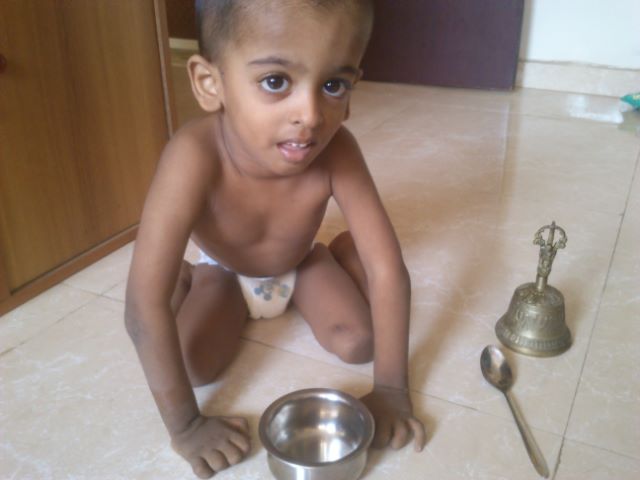
    He is also showing definite improvements with how he uses his hands. He takes out a spoon from a bowl, and then puts it back in. Gave him a rounded pot with a deep dish that fits in the mouth like a cover and he played with it in a variety of ways putting one on top of the other, putting on as lid, taking off, putting my mobile phone in the pot and putting on the “lid”… All this is new and has managed to alter habitual patterns of immediately releasing anything he grasped. All of a sudden he seems to be discovering a wide range of possibilities to try out. I believe this too is a direct result of his hands being easier to free now that he doesn’t use them as much for bearing weight.

    There is a new self awareness that has him pausing and taking stock when confronted with something new as though evaluating potential before engaging.

    His is normally constipated, but in last three days his bowel movements have been fine. Though this may be related or a coincidence.

    All in all, an exciting time and for the first time, I am experiencing that I am actually able to help him to learn movement. Strikes me anew just how much I need to learn. At the moment, it is better than last year, but many sessions don’t seem to strike any note with him. I see this as a direct result of me lacking the knowledge to choose movements that will help him. In the last few months, my skill has improved, and it is helping him dramatically.

    Note: Parents in India often ask me if I will help their child. I will, but please note that I am a self learned practitioner and am not a better option than finding a real one, which may be near impossible in India, but possible if you go abroad. Also note that I will not be able to travel to your home for it. You will have to come here, though you are welcome to come and even stay for a few days if you find it useful.

  • Update on Nisarga’s health

    To make a long story short, much has happened since I used to write here regularly (and I think I should update regularly for reasons more than memories – to record changed in health).

    Nisarga had shown no real improvement in his physical development since we started treatment. He was on increasing doses of medicine without a real diagnosis and his body was actually stiffer than it was before treatment. Doctors considered this to be a regression. I was not so sure. His legs were straight and stiff and turned inwards till the top of his feet touched each other. He had developed extreme aversions to holding anything or putting weight on his feet. No way this was better than before we started treatment, regardless of how good the doctors were.

    I had quit the physiotherapy already because of no results, and about a month back, I tapered off his medicines till he is now completely free of any treatment prescribed by doctors. This has actually helped him improve. In the last month, he is sitting up much better, he is holding objects in his hand more. He has learned to put a spoon into a bowl, interacts more, increased babbling.

    Some of it seems directly related with stopping the medications – the reduced stiffness, for example. Other things are what we achieved through the Feldenkrais method. It is the only thing that hasn’t failed us yet.

    So currently, we are only working daily with new ideas from the Feldenkrais method and eating well and loving a lot. Each day seems to open new abilities than the one before. It is tough to say when he will stand and walk, but whatever is happening daily is building on the previous day – consistently for a month now. First time I’m feeling we are on some kind of a track toward growth.

    Considering that I am learning the Feldenkrais method completely by myself, I’m going to try and update on the blog on and off as a kind of working journal.


    In other news, I was able to help two other people – a child with a hand with very limited movement and an adult with pain. If my learning continues, I hope to be able to offer help to other parents who want to help special needs children expand their physical abilities. I think I am developing some amount of reliability with my skill. This could change lives if I do it seriously.