Tag: Cerebral Palsy

  • Another day at the hospital

    Another day at the hospital

    Another Wednesday, another trip to the hospital. Our first since the big Cerebral Palsy clinic day, which had gone far less dramatic than we had been hyped up to believe.

    On the positive side, the session for speech therapy went well, with the therapist giving us several ideas on encouraging speech that ranged from toy choices and interaction styles to massage of his cheeks and mouth area. Lots of ideas with potential.

    The time spent in Room 106 with its various balancing apparatus was very useful again, like last time. We tried out a few more pieces of equipment including a rocking horse kind of thing, which Nisarga enjoyed tremendously.

    The two physiotherapy departments continue to be a pain. We have been prescribed certain exercises for him, that we must make him do, but Nisarga remains true to his history of not liking repetitive and regimented movement as well as becoming stiffer after doing it. Frankly, I agree with him, as logically, they do not appear to be headed in a direction that will contribute to his movement choices. I don’t anticipate much good to be resulting from these and am, in fact having to work harder to combat increased rigidity, both in him, and in my mind, as forcing a crying child to do exercises he is trying to escape just does not fit my view of humane.

    I also think it is dangerous, as crying is the only way he can indicate if he is in pain or other discomfort, so it may be possible to injure him by forcing him to do something he is resisting with everything he has in him. And he is not like that. Nisarga is one cooperative and cheerful guy. Uncontrolled crying is so not him at all. So I am very disturbed by these therapy sessions, particularly the one on the first floor, where the therapist is extremely uncompromising in the movements she wants him to make and Nisarga dislikes that so much that he simply refuses to have anything to do with her.

    I need to find a way to select the therapies that are helping and opt out of the ones that aren’t, in order to maximise the useful impact on him, and reduce stuff that wastes his energy with stress or adds resistance to an already difficult reality. Or at least ask the therapists to not force him and simply show us the movements, which I can try and weave into our Feldenkrais sessions. This is not going to be easy, as the husband is usually inclined to think I am a fool and don’t care about Nisarga’s well being and etc, so apart from resisting the considerable pressure from doctors to “do this if you want your son to get well”, there is the home front too. Why would I be happy to cooperate with one therapy and not another? What vendetta would I have for some therapists over others when they are all new to me? If I was resisting for the sake of it, I’d do it for the whole gig and save time traveling 4 hours every Wednesday in insane rush, no? Procrastinating. Who knows, maybe against the odds, the exercises help and I don’t have to do this battle?

    Anyway, I am noting the movements those therapists see as desirable and trying to achieve them in more respectful ways at home. Hopefully that will help. Or at least not harm.

    In other good news, the medicine Nisarga had been prescribed at the Cerebral Palsy clinic had been very difficult to find, and we had almost given up, when a short tempered nurse told (an even more short tempered) Raka something that led to me suggesting yet another attempt to find it. While Nisarga and I had a great time in the room with the balance equipment, Raka went out searching for it again and chanced to find some lane of medical wholesalers, where he finally got the medicine.

    This is very good, as my internet searches had shown me that it helps decrease spasms, which is very urgent for Nisarga, as he is not able to do a lot of actions he knows how to do, simply because of involuntary movements fouling everything. If the medicine helps dial the spasms down, that one chance search in some godforsaken lane will probably do more to help him than 10 therapists.

    Yeah, so that is that. So far, so good.

    Enhanced by Zemanta
  • Fun at the AIIPMR

    Fun at the AIIPMR

    These are two activities at the AIIPMR that really helped Nisarga. He enjoyed doing them, and he was helped by them. In contrast, yesterday’s manipulations with his foot have left him with those stiff legs I was hoping we could leave in the past…

    Tracking the impact of various elements of therapy on him, so we can choose the more useful with time. Anyway, enjoy these pics 😀

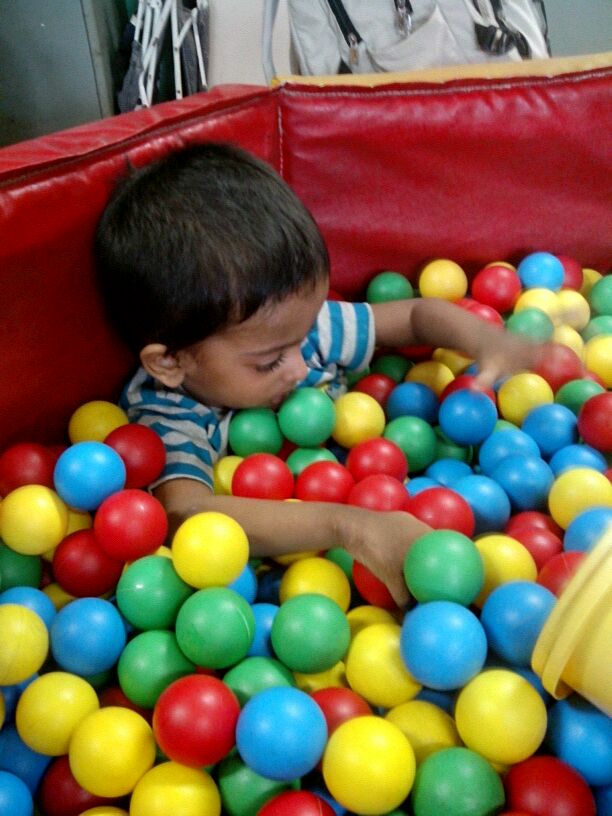
    This is a foam tank full of spongy balls.


    They put Nisarga in this tank of balls and he was happy like a fish in water. The balls seem to provide slight support as well as sort of suspend him so that he is free to take the posture he is most comfortable in, regardless of gravity. He was picking up the balls one by one and throwing them into the bucket.

    IMG-20131006-WA0003


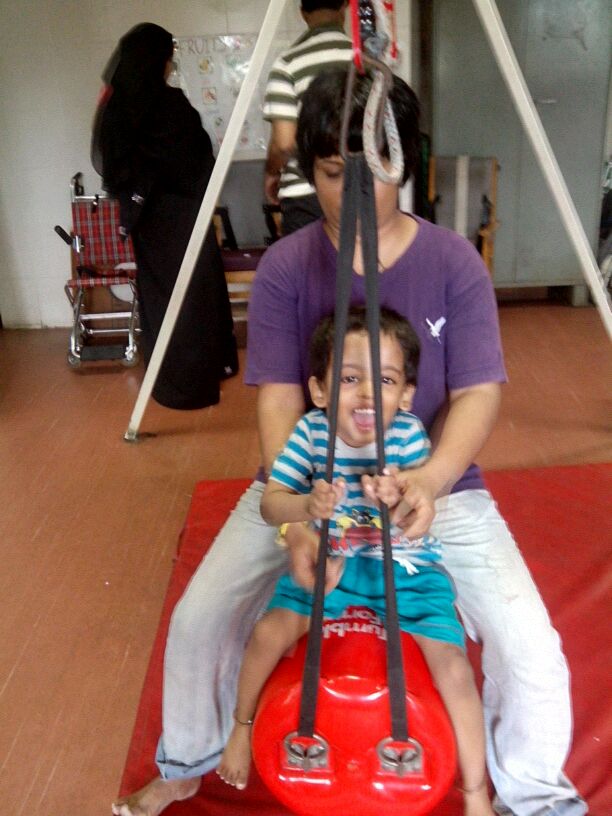
    This was another very useful activity, where he was made to sit straddled on this suspended roller and the roller was swung gently. I imagine it helps with trunk control, since at least that is what I could feel his back up to as I supported him. I sneaked in a few Feldenkrais touches and movements and I found him responding really well. The changes lasted well after the session, for a couple of days at least.

    Enhanced by Zemanta
  • Beautiful, brilliant day of learning

    I had been getting a bit pushy with Nisarga’s movement lessons. Needless to say, it was counterproductive. He was getting bored rapidly or cranky. I was getting frustrated at the lack of a breakthrough. So yesterday, I decided to back off (long overdue). I spent time reading about the Feldenkrais Method, reminding myself of what I was to do and what not to do. I watched videos on youtube. Returned to our session with a calmer mind, determined to do nothing, till it “happened”.

    And it happened. Boy how it happened!

    In one session, Nisarga learned to say “wawa” with a finger stuck in his mouth while saying “baba” so that his lips didn’t touch. Rapidly, he moved to more fingers, less fingers, stuffing T-shirt in his mouth and…. saying “wawa” erratically, but without anything preventing his lips from meeting and producing “ba” instead. Five minutes later, he was making a “guuuuh guuuuh” sound.

    I stopped while we were ahead, did some work with his back and legs and worked a bit with a “false floor” (another post about this maybe later). Today, as he was sitting straddling me as I lay on my back, he suddenly leaned forward, pushed with his legs and put his upper body weight on my arms (he still lacks strength) and voila! He was standing!!! Heavily supported and very brief, but the movement was there, the shift of weight on his legs, the straightening while pushing.

    I supported his elbows so he could put weight on them and he stood up even straighter. Transferred him to a lousy walker we have (need to get a better one) and with some encouragement and generous assistance, he was trying to pull himself into standing there as well.

    What a transformation from nothing happening yesterday, to everything buzzing today!!!

    And as always, it took me to dial down my hyperactivity, do less, listen more.

    In a brilliant, brilliant mood. Only wish I had someone who could run a camera while these moments were unfolding.


    Enhanced by Zemanta
  • Helping your special needs child move

    Disclaimer: I am not a doctor, any kind of professional related with child development or even very experienced in helping children, but I am able to use the Feldenkrais Method enough to help my son move better and I am learning daily.

    Here is a list of some of my own most important insights that help me the most when helping Nisarga to do something new. I think these are basically good ideas for any and all learning, but they become important with special needs kids, because they have limited energy to waste on things that are not useful. Where possible, I am providing my reasoning for the most common issues I run into when parents contact me for help.

    Warning: Some of these ideas will contradict what your physiotherapist says and I leave it to your judgment to choose what is most useful.

    • The goal: Forget perfection. It is not a useful goal for anyone, let alone a child who doesn’t need the pressure. No one is perfect. I can show how inefficiently your body moves, if you wish to be stuck on this.  What is important is continuous improvement. As long as each piece of learning builds on what was learned before, you’re in the green. Wait. Not so fast. Aim for a very high frequency of learning new things. Every minute is good. Every hour or every day works. Any less than that and you need to do more to help your child. It doesn’t have to be elaborate. It can be something as minor as “beating a new surface makes a new sound”. The key to recognizing this is an “aha” moment. Wide eyes, “Oh!” pause, grin that reflects a world of pride “loo what I did!”. <– this is the goal. Score as many as you can.
    • Nothing is wrong: Let go of the idea of “Wrong”. It is useless. Everything teaches something. Learn to value that. He didn’t “sit wrong”. Sitting in this way is not stable, or leaning like this will topple me. These are important discoveries too. Many results create a library of choice on what to do. Rolling over or waling is like learning t ride a bicycle too. You are able to do it not just by discovering what to do, but what to avoid as well. Celebrate those inputs for learning. The are building toward greater ability.
    • Think sharing more than training: The idea is to build possibilities for your child, not take him through motions or life. A child who cannot do something is not waiting for you to blackmail him or bribe him. He has a greater interest in sitting or standing than your bribe or anger. If you can’t raise your hand above your shoulder, it is no use me telling you I’ll buy you a laptop if you do it or yelling till you do. It is plain lack of support or bad manners. What use is an adult brain with knowledge of the movement if you can’t come up with an easier way for him? So you can’t raise your arm above your head, can you do it if you bend back or to the side? How far can you lift it? What becomes possible with the amount you CAN lift? If lifting hand fully is useful, even lifting hand somewhat is useful too. Find those uses. Let him experience that it is useful to HIM rather than something he can’t do that you expect from him.
    • Make it fun: If you’re acting like you’re saving him from disaster, it will not work. Keep your sense of fun. For example, last week, the doctor tried to teach Nisarga to put his weight on his arms by holding his elbows straight forcefully and holding him in the crawling position. Needless to say, Nisarga, not being able to crawl, did not have the strength or confidence for it, and he cried, and the doctor would have simply overruled him and continued through the crying as something necessary. I didn’t become popular when I stopped her, but two minutes later, I had him in that same position from a different starting position (which he found easier) without holding his elbows. The minute the doctor tried to get involved, he started crying and that was that. The doctor had lost his trust by making the experience unhappy for him.
    • Crying through learning is not learning: Learning is fun. The idea is that the child learns something that he can then do on his own. If the experience is an unhappy one, forcing him to a sitting position will never lead him to WANTING to sit. There’s your war lost over a battle. Even if he can, he will be likely to associate it with something undesirable. Kids are resilient, and will choose opportunities to grow by default, but it is an unnecessary hindrance a child with limited ability does not need. It does not make sense to add unpleasant experiences to be overcome in the way of their growth. No pain no gain is a myth. Science now shows that the damage indicated by the pain needs to be overcome for further progress and over-training SLOWS improvement. Star athletes no longer train to the point of pain. Your child is a star pursuing his peak performance too. Not all that different. It is very easy to over-train, over-tire a child already having difficulties with movement. Take your cues from the child, not prescriptions of what “should” be done.
    • Have variety: This is probably the most important thing, because most physiotherapy will be doing the opposite. Repititions are useless. If he’s experienced one, he’s experienced them all, except for the fatigue, which is not a useful goal. Keep changing things. If he sat up on one way, change something. Change position of hand, position of leg. Elevate his head or legs – does that help? Change direction of sitting. Change speed. Vary, vary, vary. Keep him interested, engaged, watching out for what’s changing and what that will mean. That gives him a library of what to do and what not to do faster than a movement repeated on auto-pilot.
    • Dial it down: The instinct on facing failure is to get frantic, try harder. This is counter-productive. More force into a thing that is not working only makes it more difficult to change. Slow down. Start the movement and return without doing it. Use much less force – you aren’t even planning to complete the movement, just seeing what happens like that. That laid back I’m talking. If something is not happening, back off. Take a look at what is happening without trying to fix it. You need to know what’s happening, to fix it, right? So you tried to make him stand, but he’s not able. So it is okay. Go to your starting position. How is he sitting? If you were sitting like that, would you be able to get up easily? What would you have to do *before* standing up? Is he doing it? What happens if you move him like that without making him do anything at all? Can you move him easily in the manner you would, if you were getting up? If you can’t, forget him being able to. If you can, can you get him to do that tiny initial movement without worrying about the end result? What happens? Is he able to do it? Does he move “wrong” instead? Explore, explore, explore. Forget the standing. Find out what is happening. Help him find out. If this doesn’t work, still don’t get frantic. Do something else altogether that he can do. Return here another time. Remember this: No matter how important the end resulting movement is, in your view, adding energy to something that isn’t working will only fix it in the wrong way. So that is a no-no regardless of whether something else works or not. Just forget it and other ideas will start popping up.

    These, I think are the most important things I learned to do to be able to teach Nisarga effectively. Most of these have been inspired by principles of unschooling, behavioral learning theories/experiences and the Feldenkrais Method (They aren’t all that different – only pragmatic and scientific thinking applied to different aspects). To date, if working with Nisarga runs into failure, it is guaranteed I’m doing one of these wrong, and I have to take a look at myself and consciously stop doing things that hinder progress. Usually just dialing down the hyper-activity in me will help the situation considerably.

    Hope this helps. Me not being expert or having experience talking about this, I’m not sure if it has come across clearly, but I am convinced from all my learning and experiences that all these are excellent ideas that are crucial to adopt to help learning in general and for special needs in particular and the opposite of these ideas is harmful. Feel free to use the comments to start a dialogue.

    Enhanced by Zemanta
  • Living with my son’s Cerebral Palsy

    The last day since that tentative diagnosis of Cerebral Palsy has been surreal. In many ways, nothing has changed. While my husband was very resistant to the idea of a handicapped child, I had long reconciled myself to Nisarga never being “normal” – whatever that is. For me, Nisarga is normal. He is my only child. I have no idea of how else it could be.

    I had expected the diagnosis of Cerebral Palsy for over two years now, since all my efforts to learn the Feldenkrais method to help Nisarga kept coming to ideas used for CP patients to be most useful for us as well. Not to mention that the low tonus in the trunk and curled hands were something I saw daily in my son.

    So, in a way, nothing should have changed really, beyond reconciling to a new and hectic way of life. Yet today feels different.

    He is eating well, sleeping well. I did new movements with him, he was able to push himself back in his walker for the first time today. It is almost as if the diagnosis released us from some kind of limbo we were in. As if I was unconsciously treating Nisarga’s condition as a temporary thing and postponing inconvenient things till he was better. And somehow, realizing that this was it was also a call for action to start living NOW.

    Don’t know if that makes sense, because we are most certainly happy on a daily basis, but today was …. different.

    I feel in me a resolve to not let Nisarga’s increasing weight prevent us from doing things and am actually planning on taking him out on bicycle rides with me. I have been wanting to visit local villages and interview villagers as a part of my interest in grassroots blogging for a long time, which I kept postponing because there was no one to babysit the child and so on. And bam. All of a sudden, today I feel I can take him along with me and we can have fun visiting places and seeing people and learning about them.

    Instant freedom.

    No idea what this mood is, or how long it lasts, but I hope it lasts forever.

    Enhanced by Zemanta