Tag: Nisarga

  • A day of fear

    Today, while in Nisarga’s favorite exercise room, I had Nisarga in a wheelchair, while I turned around and made space for him to sit in the pool of balls (a sensory stimulus exercise he loves). I must have turned my back on him for maybe a minute. Next thing I know, he had fallen head first to the floor behind me.

    There was no visible sign of injury, and the crying was normal after a head bump. The doctors didn’t seem overly concerned by what had happened, but I am out of my mind with fear. Not fear that he has been injured. He had been cranky since waking up this morning, but nothing added after the fall. I am terrified because it is dawning on me how big the problem really is.

    Nisarga was sitting cross legged in the wheelchair. Very stable. He even goes down slopes like this without losing balance. Yet he had managed a fall that would actually require him to make serious effort to achieve. He probably tried to reach out to me, or the activity in his eagerness, and fell out of the chair instead of losing balance (which would be impossible in the position he was sitting in).

    All day, his balance has been very bad. He has stopped sitting spontaneously as well and most of the time doesn’t even sit when told. This is a definite regression and it is not today alone – which could be explained as a bad day, upset stomach or something.

    This hospital seems to be so good, yet the results we are getting are similar to the physiotherapy. He hasn’t really learned anything new, he has forgotten things he used to do, and any exercises make him stiff. The effect of the medication too is unclear. Just like the previous times when I used to interpret any change in behavior very optimistically, only to realize later that there was no concrete change. The Feldenkrais sessions too lead to very confusing outcomes at times these days – is it because I have run out of insight, or is it because of two different ways of learning to move interfering with each other is tough to say, but I no longer get a clear understanding of what’s going on with him.

    Frankly, I am depressed today. I don’t know why he is regressing or whether his condition is getting worse, or it is a result of exercise or medicine or a combination of any of these. My hunch is that he is extremely sensitive to triggers that make him rigid, and the Feldenkrais method helps us work around them, but the rigidity of the movements of his physiotherapy trigger it. In the sense, he isn’t really able to sit like a normal child, but we had workarounds that let him sit at will, however he could. Now that the physiotherapy is trying to make him sit in specific ways he can’t, he can’t do that or the workarounds because of the rigidity. But I may be wrong.

    I am at the lowest point in terms of optimism in a long long while. I have no confidence in what I am doing with him, I have no confidence in what the doctors are doing with him, I can no longer even count on abilities we took for granted so far.

    On a personal note, the relationship with the husband is deteriorating, and I had been hoping to become independent and move out. One big deterrent was the lack of mobility for Nisarga. It is difficult to go shopping if you can’t even get the child to sit a minute while you take money out of your purse or put groceries in a bag. How does one live independently with added expenses AND not even have basic mobility to count on?

    And now that fear is magnified a hundredfold. Forget putting the child down to do something, the child isn’t even save if I turn my back while he is in a wheelchair!

    Things are looking really overwhelming. I have no choice but to move on, but I for the first time in my life I have no idea what I am moving toward other than putting one foot ahead of the other.

    Enhanced by Zemanta
  • Another day at the hospital

    Another day at the hospital

    Another Wednesday, another trip to the hospital. Our first since the big Cerebral Palsy clinic day, which had gone far less dramatic than we had been hyped up to believe.

    On the positive side, the session for speech therapy went well, with the therapist giving us several ideas on encouraging speech that ranged from toy choices and interaction styles to massage of his cheeks and mouth area. Lots of ideas with potential.

    The time spent in Room 106 with its various balancing apparatus was very useful again, like last time. We tried out a few more pieces of equipment including a rocking horse kind of thing, which Nisarga enjoyed tremendously.

    The two physiotherapy departments continue to be a pain. We have been prescribed certain exercises for him, that we must make him do, but Nisarga remains true to his history of not liking repetitive and regimented movement as well as becoming stiffer after doing it. Frankly, I agree with him, as logically, they do not appear to be headed in a direction that will contribute to his movement choices. I don’t anticipate much good to be resulting from these and am, in fact having to work harder to combat increased rigidity, both in him, and in my mind, as forcing a crying child to do exercises he is trying to escape just does not fit my view of humane.

    I also think it is dangerous, as crying is the only way he can indicate if he is in pain or other discomfort, so it may be possible to injure him by forcing him to do something he is resisting with everything he has in him. And he is not like that. Nisarga is one cooperative and cheerful guy. Uncontrolled crying is so not him at all. So I am very disturbed by these therapy sessions, particularly the one on the first floor, where the therapist is extremely uncompromising in the movements she wants him to make and Nisarga dislikes that so much that he simply refuses to have anything to do with her.

    I need to find a way to select the therapies that are helping and opt out of the ones that aren’t, in order to maximise the useful impact on him, and reduce stuff that wastes his energy with stress or adds resistance to an already difficult reality. Or at least ask the therapists to not force him and simply show us the movements, which I can try and weave into our Feldenkrais sessions. This is not going to be easy, as the husband is usually inclined to think I am a fool and don’t care about Nisarga’s well being and etc, so apart from resisting the considerable pressure from doctors to “do this if you want your son to get well”, there is the home front too. Why would I be happy to cooperate with one therapy and not another? What vendetta would I have for some therapists over others when they are all new to me? If I was resisting for the sake of it, I’d do it for the whole gig and save time traveling 4 hours every Wednesday in insane rush, no? Procrastinating. Who knows, maybe against the odds, the exercises help and I don’t have to do this battle?

    Anyway, I am noting the movements those therapists see as desirable and trying to achieve them in more respectful ways at home. Hopefully that will help. Or at least not harm.

    In other good news, the medicine Nisarga had been prescribed at the Cerebral Palsy clinic had been very difficult to find, and we had almost given up, when a short tempered nurse told (an even more short tempered) Raka something that led to me suggesting yet another attempt to find it. While Nisarga and I had a great time in the room with the balance equipment, Raka went out searching for it again and chanced to find some lane of medical wholesalers, where he finally got the medicine.

    This is very good, as my internet searches had shown me that it helps decrease spasms, which is very urgent for Nisarga, as he is not able to do a lot of actions he knows how to do, simply because of involuntary movements fouling everything. If the medicine helps dial the spasms down, that one chance search in some godforsaken lane will probably do more to help him than 10 therapists.

    Yeah, so that is that. So far, so good.

    Enhanced by Zemanta
  • Fun at the AIIPMR

    Fun at the AIIPMR

    These are two activities at the AIIPMR that really helped Nisarga. He enjoyed doing them, and he was helped by them. In contrast, yesterday’s manipulations with his foot have left him with those stiff legs I was hoping we could leave in the past…

    Tracking the impact of various elements of therapy on him, so we can choose the more useful with time. Anyway, enjoy these pics 😀

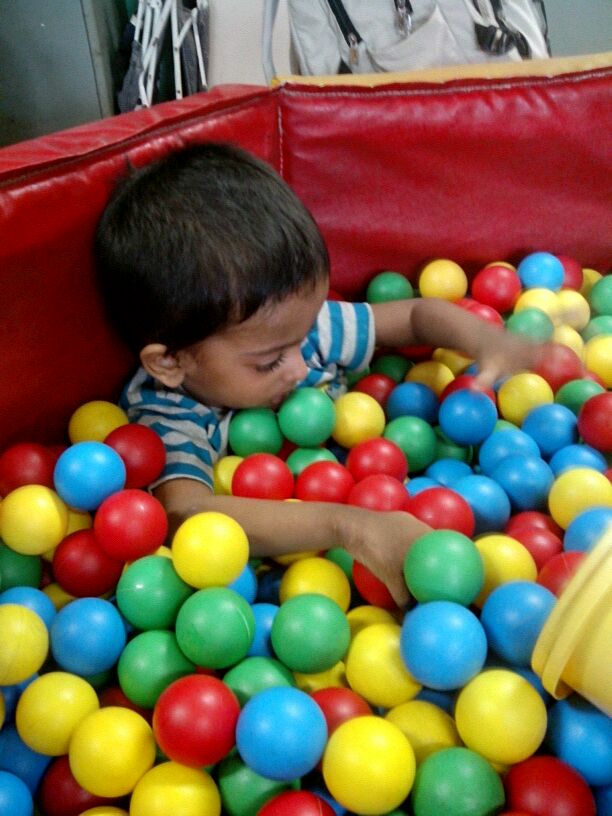
    This is a foam tank full of spongy balls.


    They put Nisarga in this tank of balls and he was happy like a fish in water. The balls seem to provide slight support as well as sort of suspend him so that he is free to take the posture he is most comfortable in, regardless of gravity. He was picking up the balls one by one and throwing them into the bucket.

    IMG-20131006-WA0003


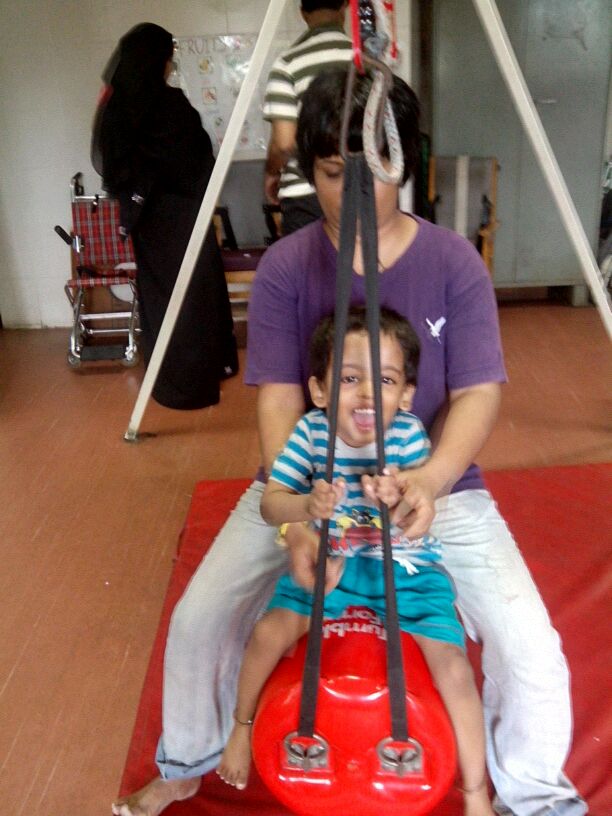
    This was another very useful activity, where he was made to sit straddled on this suspended roller and the roller was swung gently. I imagine it helps with trunk control, since at least that is what I could feel his back up to as I supported him. I sneaked in a few Feldenkrais touches and movements and I found him responding really well. The changes lasted well after the session, for a couple of days at least.

    Enhanced by Zemanta
  • Beautiful, brilliant day of learning

    I had been getting a bit pushy with Nisarga’s movement lessons. Needless to say, it was counterproductive. He was getting bored rapidly or cranky. I was getting frustrated at the lack of a breakthrough. So yesterday, I decided to back off (long overdue). I spent time reading about the Feldenkrais Method, reminding myself of what I was to do and what not to do. I watched videos on youtube. Returned to our session with a calmer mind, determined to do nothing, till it “happened”.

    And it happened. Boy how it happened!

    In one session, Nisarga learned to say “wawa” with a finger stuck in his mouth while saying “baba” so that his lips didn’t touch. Rapidly, he moved to more fingers, less fingers, stuffing T-shirt in his mouth and…. saying “wawa” erratically, but without anything preventing his lips from meeting and producing “ba” instead. Five minutes later, he was making a “guuuuh guuuuh” sound.

    I stopped while we were ahead, did some work with his back and legs and worked a bit with a “false floor” (another post about this maybe later). Today, as he was sitting straddling me as I lay on my back, he suddenly leaned forward, pushed with his legs and put his upper body weight on my arms (he still lacks strength) and voila! He was standing!!! Heavily supported and very brief, but the movement was there, the shift of weight on his legs, the straightening while pushing.

    I supported his elbows so he could put weight on them and he stood up even straighter. Transferred him to a lousy walker we have (need to get a better one) and with some encouragement and generous assistance, he was trying to pull himself into standing there as well.

    What a transformation from nothing happening yesterday, to everything buzzing today!!!

    And as always, it took me to dial down my hyperactivity, do less, listen more.

    In a brilliant, brilliant mood. Only wish I had someone who could run a camera while these moments were unfolding.


    Enhanced by Zemanta
  • Living with my son’s Cerebral Palsy

    The last day since that tentative diagnosis of Cerebral Palsy has been surreal. In many ways, nothing has changed. While my husband was very resistant to the idea of a handicapped child, I had long reconciled myself to Nisarga never being “normal” – whatever that is. For me, Nisarga is normal. He is my only child. I have no idea of how else it could be.

    I had expected the diagnosis of Cerebral Palsy for over two years now, since all my efforts to learn the Feldenkrais method to help Nisarga kept coming to ideas used for CP patients to be most useful for us as well. Not to mention that the low tonus in the trunk and curled hands were something I saw daily in my son.

    So, in a way, nothing should have changed really, beyond reconciling to a new and hectic way of life. Yet today feels different.

    He is eating well, sleeping well. I did new movements with him, he was able to push himself back in his walker for the first time today. It is almost as if the diagnosis released us from some kind of limbo we were in. As if I was unconsciously treating Nisarga’s condition as a temporary thing and postponing inconvenient things till he was better. And somehow, realizing that this was it was also a call for action to start living NOW.

    Don’t know if that makes sense, because we are most certainly happy on a daily basis, but today was …. different.

    I feel in me a resolve to not let Nisarga’s increasing weight prevent us from doing things and am actually planning on taking him out on bicycle rides with me. I have been wanting to visit local villages and interview villagers as a part of my interest in grassroots blogging for a long time, which I kept postponing because there was no one to babysit the child and so on. And bam. All of a sudden, today I feel I can take him along with me and we can have fun visiting places and seeing people and learning about them.

    Instant freedom.

    No idea what this mood is, or how long it lasts, but I hope it lasts forever.

    Enhanced by Zemanta
  • Feldenkrais method for kids: Sitting straighter, using hands more

    Feldenkrais method for kids: Sitting straighter, using hands more

    Posture Analysis:

    Nisarga’s development seemed stuck with him sitting hunched, braced against his hands or rather the back of his hands. Looking at some videos of using the Feldenkrais Method with kids and reading and mimicking his posture, I realized that this too is a manifestation of him not using his lower back. His knees turn inward as well and muscle tension is a constant to overcome for most movements. He was not comfortable sleeping on his back, though he is able to sleep on his back easily now after some work I did last month. When crawling, his legs stick straight out and stiff without movement. There is very little self awareness that can be leveraged to help him differentiate these movements enough to alter habitual patterns.

    Nisarga W-sitting

    His hands are often clenched and he avoids touch on the palm of his hands, preferring to use the back of his hands to push against the floor. Similarly, he avoids contact with the soles of his feet, lifting his legs if you try to stand him up or not bearing any weight on them. There is hardly any muscle tone. Recent sessions have allowed him to be comfortable resting them on the floor while in a rocking chair or walker, without putting weight on them.

    In terms of posture analysis, he is often like a diver in the middle of a somersault. Upper body curved, legs tight together, straight out at an angle. Except he also hunches his shoulders in and his legs turn inward as well.

    The Feldenkrais Method resources I found useful for this:

    It was easier said than done, but three consecutive movement therapy lessons based on functional integration movements from Yochanan Ryewerant’s book “The Feldenkrais Method: Teaching by Handling” have shown small but definite improvements. I also got many practical ideas from Michelle Turner’s excellent video series on Functional Integration lessons with children using the Feldenkrais Method.

    The Feldenkrais Method Functional Integration movements I did:

    Self awareness is half the battle. In various functional integration movements, I helped him learn to move his pelvis to support his lower back better, resulting in an immediate straightening of his spine while his lower back was engaged. Particularly useful was gently rocking his pelvis forward while he played and touching the top of his head so he had some self awareness how he became taller as his back straightened. Rounding his back by pushing lightly from his lower chest and then straightening it by pressing lightly on his lower back.

    I did another variation of this with him lying on his side, which really seemed to register on his self awareness as it is not a movement we do normally and he did not have to worry about bearing weight or balance. Additionally, and possibly unrelated, I worked with very gentle movements of his toes till his legs started relaxing more. I think the muscle tension in his whole body relaxed and there was more ease, but it was not such an immediately observable change for whole body.

    I was not able to video shoot these functional integration lessons, because I don’t have anyone assisting me and also because he becomes instantly distracted by a camera. I have never been able to set it up without him noticing.

    He still forgets to sit straight, but now that he can, if he wants to, he is able to do a lot more movements than before. All of a sudden. Adding something new with each session.

    The Results

    He still uses his hands for balance, but is sitting up more often and also uses his hands for balance more often than bearing his weight. He has started rocking back and forth while sitting in a W-sit. He has started enjoying being rocked side to side (shifting weight from one buttock to the other) if done in rhythm with music. He has started using the palms of his hands more often than the back of his hand, which was usual up to this series of functional integration lessons.

    He used to grab my hair to pull my head down to plant kisses on it all the time. He loves it. So I have started not bending when he pulls and letting him come up to me instead. He has started pulling himself up on his knees if he can get a fistful of my hair (it hurts, but considering that it is one of the very few things he grabs strongly and willingly, I am glad he does it). His back is not strong enough to do it well yet, but once in a while he surprises himself by standing on his knees. Grin, kiss, fall back into a sit. This is something he had started briefly last month, but is able to do it slightly better after these sessions.

    He has started babbling a lot more and using his hands more readily.

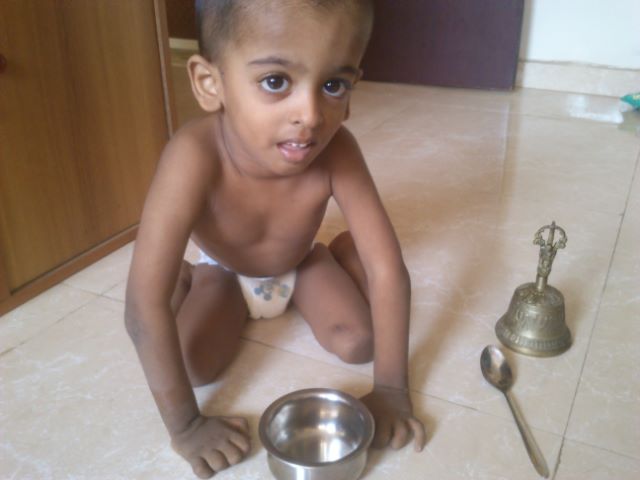
    He is also showing definite improvements with how he uses his hands. He takes out a spoon from a bowl, and then puts it back in. Gave him a rounded pot with a deep dish that fits in the mouth like a cover and he played with it in a variety of ways putting one on top of the other, putting on as lid, taking off, putting my mobile phone in the pot and putting on the “lid”… All this is new and has managed to alter habitual patterns of immediately releasing anything he grasped. All of a sudden he seems to be discovering a wide range of possibilities to try out. I believe this too is a direct result of his hands being easier to free now that he doesn’t use them as much for bearing weight.

    There is a new self awareness that has him pausing and taking stock when confronted with something new as though evaluating potential before engaging.

    His is normally constipated, but in last three days his bowel movements have been fine. Though this may be related or a coincidence.

    All in all, an exciting time and for the first time, I am experiencing that I am actually able to help him to learn movement. Strikes me anew just how much I need to learn. At the moment, it is better than last year, but many sessions don’t seem to strike any note with him. I see this as a direct result of me lacking the knowledge to choose movements that will help him. In the last few months, my skill has improved, and it is helping him dramatically.

    Note: Parents in India often ask me if I will help their child. I will, but please note that I am a self learned practitioner and am not a better option than finding a real one, which may be near impossible in India, but possible if you go abroad. Also note that I will not be able to travel to your home for it. You will have to come here, though you are welcome to come and even stay for a few days if you find it useful.